

Image by Mollyroselee from Pixabay
Before finding a solution, we first need to find the problem.
In last month’s post, I looked at two problems that we had solved. The first, insufficient housing and supporting infrastructure in the 1950s, was obvious and the solution simple. The second, asset renewal in the mid 1980s, took some finding, and the solution was far from simple, but once we understood what we had to do, we were able to do it. These are not our problems today, but what is? Fortunately, commentators on that last post have given us some clues. What do you think?
@Hein Aucamp observed that
“The first incarnation of AM tended to be asset-centric, renewal-based. Now it has moved to ever-greater levels of strategic consideration, delivering organisational value and services across an increasing set of measures, including sustainability. If AM stops taking into account emerging areas of value, it will definitely become less useful.”
Q1 Hein is right, it will. The question is, how can we know where to start and which new or emerging area to devote time to? What criteria could we use?
@Gregory Baird agreed with Hein that the AMgr’s work is broadening.
“Leaders can feel it: the work is getting more complex. Rates, regulations, climate, workforce, customer expectations — everything is moving, and everything is connected. Asset management can’t stay in its old lane”.
He suggested, “The next evolution is Integrated Infrastructure Stewardship — a holistic approach that blends financial architecture, demand behaviour, risk modelling, digital intelligence, and governance maturity into one continuous decision system. This is more than planning. It’s the operating model for the next generation of resilient cities and utilities. And it’s where the real opportunity lies for leaders who want to build systems that last.”
As exciting as this sounds, in theory, is it possible in practice? The AMgr, even the AM team, is no superman. Forty years ago, the problem was relatively simple. We knew the focus was asset renewal; we knew what we had to do, at least in principle, to get it. The Life Cycle Renewal Model gave us a tool and an approach.
Q2 Where is today’s ‘key question’ and what tools and approaches do we now need? Is the Life Cycle Renewal Model relevant to our new problems/
@Ian Greenwood challenges the idea that we have to be all things to all men. He argues,
“While the more advanced parts of AM have benefited a small group of infrastructure entities where chasing the 4th decimal point of reliability is of value, IMHO, the vast majority would benefit from just getting the basics right and avoiding the distractions of all the shiny bells and whistles.”
Q3 Do you agree? Is the ‘excitement of the new’ luring AMgrs into fields where they are able to contribute very little? And, if so, how do we, as an industry, cope with that?
@Martin Grey avoided the ‘do everything’ approach and focused on just one, ‘managing uncertainty’. He argued that
“Recognising and actively managing uncertainty is essential for making better decisions in the present and shaping more informed decisions in the future. This, of course, depends on having the right management information in place—supported by a continuous improvement capability that identifies emerging trends early, enabling timely intervention before issues escalate into incidents or crises.”
Q4 This got me thinking. I like the one-point focus, but does ‘managing uncertainty’ really depend on having ‘the right management information in place? ‘ If it truly does, we are done for. Not the least because it is probably impossible to tell in advance what the ‘right’ information is. And whatever it is, we probably don’t have it.
But surely it is right to focus on ‘continuous improvement capability’. Sounds exhausting, doesn’t it? But in the early days of asset management, that was what we were all doing.
@Philip Tiewater. His comment on the Talking Infrastructure blog is qualitatively different from the earlier comments. Philip says,
“This is a timely topic. In many cases, the infrastructure we have is not as necessary as once thought. Shifting commuting patterns, new regulations, and sea-level rise should drive more conversations about devolution (paved roads to dirt roads), repurposing (vehicle bridges to pedestrian bridges), and removal (replacing traffic signals with roundabouts) rather than life extension. The lowest-cost lifecycle decision is often not to (re)build it in the first place.”
Q5 I like this for it applies basic AM thinking to making ‘fit for the future’ AM decisions, and recognises that this applies not only to new assets but also to the replacement and modification of existing assets. What do you think?
OK. Here we have five suggestions. Where do we go from here?
My sincere thanks to Hein, Gregory, Ian, Martin and Philip.

In the debate about public versus private ownership of infrastructure, one thing is clear: we don’t need predators.
In the 1980s, some free market entrepreneurs argued that we should design policy and society to give free rein for what they called predators – themselves, in other words – to predate.
And then their predatory eyes fell on physical infrastructure.
Having already asset-stripped manufacturing companies, they need fresh blood. And this time we were all the prey.
We depended on adequate government regulation, but predatory thinking infested our governments.
We can fog this with talk of efficiency, innovation, managing public debt and use of private capital, but ‘extractive predation’* is much snappier.
*From Foundational Economy (2022)
See also Hettie O’Brien, The Asset Class: How Private Equity Turned Capitalism Against Itself (2026)

ID 72282390 | Cane Toad © Seregraff | Dreamstime.com
In 1935, Queensland was suffering significant damage to its sugarcane crop from the cane beetle. To contain the beetle, 101 toads were released. They were expected to eat the beetles, but they didn’t. Instead, they thrived, spreading rapidly; today, these poisonous toads present a serious and worsening problem across northern Australia, moving southwards.
In this way, what was thought to be a solution ended up being a problem. The toads failed to solve the initial problem; the cane beetle remains, although the cane toads themselves are far more concerning. This is a story well known in Australia. Even successful solutions, acknowledged by all, may still become a problem if continued beyond their time.
In the 1950s, Australia faced a major housing problem. The combination of returned soldiers, the beginning of the ‘baby boom’ and increasing numbers of refugees and migrants led to a rapid rise in population. Demand for housing so far outstripped supply that it was not uncommon for three families to share one house. This, indeed, was the situation for my family when we arrived in 1950. The problem was visible and obvious to all, and the Government addressed it by funding large housing estates. The companies paid to undertake this work grew in size because that was what was needed to get the job done. They were successful.
In the mid 1980s, Australia faced a new problem; infrastructure assets were approaching the age at which they would need renewal, and this hadn’t been planned for. This time, the problem was not at all obvious; it was not until the cost of capital consumption had been recognised, enabling the likely, and extremely high, future costs of infrastructure asset renewal to be demonstrated, that it was recognised as needing attention. This was not amenable to a simple ‘throw more money at it’ solution as the earlier problem had been, and, in any case, the Government no longer had plentiful funds. This problem needed a very different solution, and it found it in the development of a new class of specialists: the Asset Managers.
But back to our cane toads. The extreme urgency of the housing problem had largely passed by the mid-1960s, but the development companies, now very large and influential with the Government, were able to encourage continued growth of infrastructure. However, as Asset Managers strove to bring the renewal problem under control, it became clear that creating new infrastructure only made the task of renewal more difficult, as demonstrated by two major case studies in Victoria and South Australia.
Now, cane toads and large development companies are not malevolent; they are simply aiming to survive, as all organisms and organisations are designed to do.
Where do we, as Asset Managers, stand? Before assuming we are all necessarily on the side of the angels, we need to consider that we can, in our turn, also become cane toads. When the need was to plan for and manage renewal, we were the solution. To address that problem, we considered extending the lifespan of our existing assets; this gave us time to plan for change. And we had time! While we could see what needed to be done, it didn’t have to be done immediately. So we adopted a slow and thoughtful way of moving. Is this still appropriate? Life cycle renewal models were then our tool of choice. Are they still?
Are we acting as if the problem of the mid-1980s remains today’s problem, and that asset longevity is the solution? It isn’t. In today’s rapidly changing world, flexibility needs to trump longevity. Also, the very idea of what infrastructure is, and what it is for, has grown far beyond the simple ideas we had 35 years ago.
Are we moving on? Talking Infrastructure was created to address the problem of decision-making for ‘fit for the future’ infrastructure. What should be our new aims and objectives? And what new tools and techniques are we developing to address them? Unless we constantly adjust and learn, today’s Princes of Asset Management can easily turn into frogs – or, worse, into cane toads.

ID 6497422 © Hans Slegers | Dreamstime.com
Several of us on the Talking Infrastructure Board will never write an AMP again.
That is, we are retired from paid AM work; but then we already have maybe 150 years of experience of Asset Management between us.
Using the Waves concept created by Penny Burns and Jeff Roorda, we propose two roads ahead for Talking Infrastructure.
The first, working title The Way of the AMP, is to collate and disseminate what we know about Wave 2 strategic Asset Management in useful formats, including Penny’s SAM archives. But we want to do more than capture current practice: we want to challenge and stretch AM practice within infrastructure organisations, including better risk, strategy and information management. People who are still pioneers in this space include Jeff Roorda and Todd Shepherd.
For this we are bringing in more and younger people still developing in their AM careers around the globe to add and challenge.
The second is to go beyond Wave 2, to ask better questions about infrastructure decision-making in our societies. Here, some current AM thinking may be part of the problem, not the solution to the challenges we face in the 2020s.
What are the infrastructure-related issues now? How have they changed since Penny created AM in the 1980s, to deal with problems inherited from the 1950s post World War II?
What does it mean to be a future friendly infrastructure planner in 2026?
Your input, please.

© 2026 NASA, from April 7
Well, the world did not end last night.
But something has become clear. Targeting weapons at infrastructure such as bridges and power networks is a war crime.
From some of the most miserable moments of the last 130 years emerged the idea that some things are always wrong, whoever does them – even before there was anything like clear international law against them. This lead directly to the Geneva conventions and human rights courts.
Destroying critical infrastructure, starting with water and sewerage, roads and power, is an attack on non-combatants. It undermines civilisation, as in digging a big hole under society that may not be repairable.
As infrastructure asset management practitioners, we are involved in life-changing decisions whether we realise it or not.
If it is always wrong to target the infrastructure people depend on to live, it’s also vital to commit to maintaining what is needed. To ensuring we have the skills and tools and democratic processes for infrastructure.
Time for an Infrastructure Code of Ethics?

Our mission at Talking Infrastructure is to promote the good practices of Asset Management Wave 2 and develop thinking on Waves 3 and 4.
It’s an evolutionary model: you need the solid processes of whole life costing, sophisticated risk thinking, and longer-term asset planning both for the sake of your own organisation’s ability to deliver and to underpin (to ground) decisions on new infrastructure and new types of assets.
So we plan to:
- Continue to promote better strategic Asset Management, Wave 2, through re-emphasising the core AM tool of longer-term asset planning as well as development of more sophisticated asset risk and decision-making concepts
- Develop a guidebook to the AMP, to restate and update Penny’s original vision for the changing contexts of the 2020s, with case studies such as Grant County PUD
- We would also like to see campaigning for infrastructure regulators to have more teeth through AMP requirements and audits to encourage agencies to plan ahead
Plan for work on Wave 3, infrastructure decision making especially on new and renewed assets includes:
- Promote work already done, such as the UK Projects and Infrastructure Project Routemap module on Asset Management, https://projectdelivery.gov.uk/library-product/project-routemap-asset-management-module/ and our latest book Legacy: A Decision Maker’s Guide to Infrastructure
- There is a still a long way to go to shift from a construction delivery and short-term profit focus to planning the right assets and asset strategies in the first place. Shout out to Louise Hart working on how to succeed at infrastructure megaprojects (linkedin.com/in/louisehart750), and Johannes Paradza of Infrastructure Asset Management South Africa on how asset managers help meet the challenge of Cape Town’s infrastructure.
Resources on Wave 4, starting with Jeff’s work as Director of Infrastructure and Biodiversity at the Blue Mountains City Council
For all of these, we aim to build on friendly alliances with like-minded people and organisations.
Your input, please, on:
- In your experience, in what ways is Wave 2, strategic Asset Management, still not yet where we should be?
- Anything you already know of on Wave 3, better infrastructure decision-making in our communities?
- Inspiring examples on resilience, biodiversity, radically sustainable thinking on assets – away from grey assets?
What’s in your plan for 2026?
Just because it reminded us of the computer in the original BBC Hitchhiker’s Guide to the Galaxy
This year, Asset Management turns 42. And we all know what that means…
Is there one, main thing we can do in organisations that will lead to good Asset Management?
On the one hand, 39, now 40 subject areas, ISO 55000 clauses, and AM maturity assessments with tens if not hundreds of questions all suggest there are many things we have to do.
On the other, some of us suspect AM is a paradigm which may only need one assumption to be thoroughly overturned to flip the system.
If I had to bet, it would be the concept of an asset lifecycle model – a model not really about money, but what we need to do to an asset, or an asset class, to effectively manage it over time to meet demand.
However, the evidence for this is more, as they say, in the breach: most infrastructure organisations haven’t yet got explicit whole of life models. Have not tried this switch.
But watch this space…
Next comes a blog summarising what Talking Infrastructure needs to do in 2026. How about you?
Happy New Year from the Talking Infrastructure Board!
My last post examined Thomas Kuhn, who gave us the language of paradigm shifts, here, I’d like to look at a book by Michele Wucker* who gave us the image of the Gray Rhino: a massive, obvious threat we can see coming but still fail to confront.
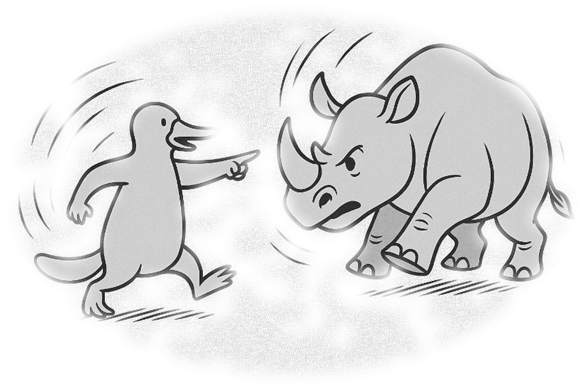
Where Kuhn focused on how systems break and are replaced, Wucker draws attention to the crises we recognize but still choose to ignore.
Asset Management exists at the intersection of these two frameworks.
Asset-intensive organizations are surrounded by gray rhinos. Infrastructure gaps, aging systems, climate vulnerability, workforce attrition, regulatory pressure: these are not surprises. They are slow-moving, well-documented challenges that, if left unaddressed, will overwhelm the system we rely on.
Yet for all their visibility, these threats rarely trigger the level of change they demand. Instead, they are absorbed into routine. Budget cycles roll forward. Work orders are prioritized by urgency rather than consequence. The language of Asset Management is invoked, but its paradigm is never fully adopted. We name the problem but struggle to act on it.
Asset Management offers an approach precisely designed to engage these looming risks. It asks us to plan, to prioritize, to see beyond the emergency response. It invites organizations to realign their values, moving from reactive service delivery to deliberate, long-term stewardship.
But as Kuhn would note, this requires a change in the underlying logic, a shift in how organizations understand value, success, and time.
Until that shift happens, Asset Management remains vulnerable to reinterpretation. The system continues to operate within the old paradigm, where short-term efficiency trumps long-term value, and where the urgency of today erodes the preparation for tomorrow.
This is not a failure of awareness. It is a failure of transformation. We see the gray rhino, and we have a framework for responding to it. But our systems, both technical and cultural, are still optimized for a different reality.
So, what do we do with this tension?
We start by recognizing that paradigm shifts don’t come from force. They come from readiness.
And readiness grows in moments of discomfort, when the cracks in the current system become too wide to ignore. When organizations feel the weight of the gray rhino pressing closer, they become more open to doing things differently.
Asset Management must be positioned as more than a practice. It must become a way of seeing the world around us. Using a lens where the familiar takes on new meaning and is a guide for what to do when the warning signs are no longer abstract.
Most importantly, Asset Management needs its champions. People who can not only name the gray rhino and frame the conversation but offer a path forward that is both pragmatic and bold.
Change can be slow, but it is also inevitable. Those that prepare will be the ones best positioned when the shift finally takes hold.
The gray rhino is here. The question is whether you will continue to ignore it or finally take action to avoid being trampled.
*The Gray Rhino: How Recognize and Act on the Obvious Dangers We Ignore, Michele Wucker, 2016
This is a follow-up to Julie’s and my first post. This comes from discussions with Ruth, as we are both fans of Kuhn and approaching Asset Managment from a Systems Thinking bend.
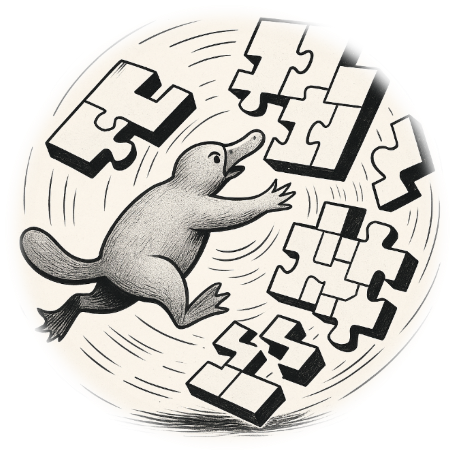
Asset Management isn’t failing, but it is struggling. It’s struggling because it asks for something most organizations aren’t ready to give: a change in worldview.
In his seminal work The Structure of Scientific Revolutions, Thomas Kuhn argued that progress in science doesn’t move forward in smooth, logical steps. Instead, it lurches forward through upheaval.
An existing model, what Kuhn calls a paradigm, organizes how people understand and act in the world. When that model starts to break down under the weight of anomalies it can’t explain, a crisis forms. Eventually, a new model takes hold. Not by refining the old one, but by replacing it entirely.
Asset Management isn’t a toolkit upgrade. Asset Management is a paradigm shift.
The prevailing paradigm in many organizations see assets as cost centers. Value is measured in terms of budget variance, performance is gauged by how fast we respond to failure, and success means keeping operations running despite broken systems and shrinking resources. This is the logic of firefighting, not foresight.
Asset Management offers a radically different frame. It suggests we treat assets as value-producing systems. These decisions should be based not only on today’s conditions but on long-term impacts. That success means reducing failure, not merely reacting to it quickly. And that the ultimate responsibility of an organization is to deliver reliable, sustainable service—not just to manage budgets.
But here’s the problem, and Kuhn would recognize it: paradigms don’t go quietly. The existing mindset fights back. Asset Management is often taken in and translated through the old lens. We say we’ve adopted Asset Management, but we’re still rewarding short-term fixes. We talk about lifecycle value, but we still plan one year at a time. We build dashboards and risk models, but we still defer investment until failure forces our hand.
This is normal. According to Kuhn, when a new paradigm first appears, it doesn’t make sense within the old logic. People struggle to see its relevance. They may accept some of its tools, but not its worldview. The old questions remain, and the new answers seem off-topic.
Real change happens only when the organization starts asking new questions. Not just, “How do we save money this year?” but “What will this decision cost us over the next 30?” Not, “How fast did we respond to the outage?” but “Why did the outage happen at all?”
That’s when a shift begins.
A true Asset Management transformation doesn’t begin with data, or systems, or even leadership mandates. It begins with discomfort, when the old paradigm can no longer explain the failures piling up around us. When firefighting becomes too exhausting, too expensive, too visibly ineffective. Then, and only then, do people become open to a new way of thinking.
So, the task isn’t just to implement Asset Management. It’s to create the conditions where the old worldview can be questioned. That means:
- Telling stories that expose the cost of reactive practices
- Measuring success in ways that reward foresight
- Giving voice to people who see the long game
- Protecting Asset Management from being reinterpreted as just another compliance exercise
Paradigm shifts are hard. They are political, cultural, and emotional. But they are also the only way real progress happens. Asset Management doesn’t need to fight harder. It needs to be ready to lead when the cracks in the old system finally become too big to ignore. It needs to be there to offer a better forward.
Link to Ruth’s article: AM, Capital-ism and Shifting Paradigms | Talking Infrastructure
Julie and I produced this after a recent discussion with Ruth. I think it’s a discussion we’ve been having for years.
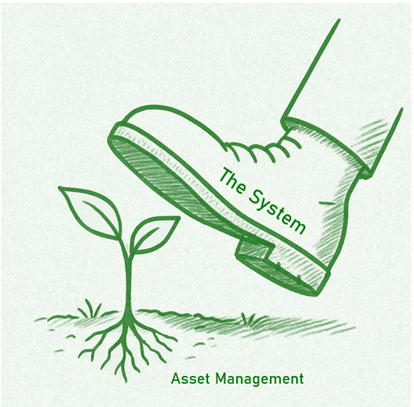
Todd Shepherd & Julie DeYoung
Once upon a time, or so the story goes, Asset Management started to take sprout at our organizations with a bold promise. It came to guide us toward long-term thinking, to help us look beyond next year’s budget and into the decades ahead. It came with principles and frameworks, a philosophy that assets are not isolated items, but interconnected parts of a whole. The decisions we make today shape the quality of life for future generations. It was a different way of seeing how investing in the right place, at the right time, could save money, and public trust.
But then Asset Management met The System. And The System did what it always does: it absorbed the new idea and bent it back into something familiar.
Instead of being a strategy for long-term stewardship, Asset Management became a new label for what we were already doing. We turned it into a more refined version of the same habits: squeezing the last bit of life out of aging assets, reacting quickly to failures, and deferring investment until the next crisis hit. We framed these actions as efficiency, as cost savings, as smart business. But they were just survival tactics. And so, when Asset Management started to bloom, it was quietly, subtly, reshaped.
What was meant to be transformational became transactional.
Long-term planning? That would have to wait. We needed to fix the latest failure, explain the recent cost overrun, patch the emergency before the news cycle caught wind. The capital planning calendar was full of yesterday’s fires. Asset Management was drafted into service as a better way to react.
Rather than change The System, Asset Management was absorbed by it. It was translated into the language of short-term cost savings and immediate returns. “Get more life out of your assets” became a directive, not to optimize lifecycle value, but to defer replacement as long as humanly possible. And The System applauded. Budgets tightened. Work orders increased. Failure response times improved…until they didn’t.
This isn’t a failure of individuals. It’s what happens when a new idea runs headlong into The System. The System reward firefighting over fire prevention. It promotes leaders who solve today’s crises, not those who quietly prevent tomorrows. It allocates resources to what is visible, immediate, and politically expedient. And so, Asset Management is quietly reshaped until it fits.
A discipline focused on resilience and long-range value becomes a sophisticated way to do what we’ve always done: squeeze, stretch, defer, and repeat.
Asset Management, instead of being a disruptor, became domesticated.
The truth is, Asset Management requires a paradigm shift. It requires a new way of thinking about value, responsibility, and time. It asks us to see past short-term wins and start building for long-term resilience. It asks leaders to stop managing symptoms and start addressing root causes. It asks organizations to measure success not by how fast they respond to failure, but by how rarely failure occurs at all.
That’s a hard shift to make. It means unlearning habits, changing incentives, and having the patience to invest in what won’t pay off this quarter. It means making space for new voices, new metrics, and sometimes uncomfortable truths.
But if we want Asset Management to be more than a buzzword, we need to protect it from the status quo. We need to give it space to grow before we ask it to perform. And most of all, we need to let it change us before we change it.
To do that, leaders must become designers of systems, not just managers of outcomes. They must ask: What behaviors are we rewarding? What stories are we telling? Are we building a future, or just managing decline?
Asset Management didn’t fail. It simply wasn’t given a chance to take root. But the story isn’t over. It’s still being written. And if we’re willing to change the system, we might just change the ending.
Recent Comments