

© Cammeraydave | Dreamstime.com
ISO 55000 defines asset management as the coordinated activity of an organization to realize value from assets.
I like the word co-ordinated, but I was never so sure about ‘value’.
That AM should be driven by the organizational objectives and targets was defined well before ISO 55000. Physical assets are managed in order to support a company doing what it aims to do, not for their own sake.
If the aims are evil, it follows the asset management isn’t going to be for the angels either.
Not long before it collapsed, I interviewed two Enron asset managers in London. They told me their main job was to know who to bribe and how far you could go before you were thrown in jail. (I suspect they knew the end was near.)
In practice, for many of us, the bigger problem we face is not evil targets, but missing or stupid ones. Organisations don’t know what it is they want their organisation to deliver, other than not making a loss or a scandal. For infrastructure, it surely has to be a service for customers & the community; but how to set meaningful key performance targets for service is often hard work.
Transit has struggled with this forever, but even power generation gets muddled. In markets with shifting prices, what is the amount of electricity we want to produce at any specific time? Apart from anything else, the answer has to involve costs, like spot cost per megawatt, and plenty of power organisations don’t know that. (I’d say rail generally doesn’t have a clue of their cost per passenger mile.)
We default to targets like minimising unplanned outages, because that’s relatively simple. Or even more asset-specific measures like pavement condition index. (Aaargh!)
I am convinced the person who came up with the ISO 55000 definition felt clever – clever to avoid saying ‘lowest cost’ or ‘least risk’. Value is whatever an organisation thinks it is. (And we won’t define ‘asset’ very clearly, either.)
It’s out of scope to discuss where the value comes from or how to capture it in SMART targets.
Quite apart from the evil ones, and our own ethics as asset managers, I believe we have a real challenge with stupid or missing targets. In practice, we cannot just aim to be aligned, if there is nothing that makes sense to align with.
Smart asset managers get drawn into the question of organisational KPIs. I know I was. I think setting meaningful infrastructure targets is closely allied to good AM thinking.
And as for all that missing cost analysis….
Anyone fancy attempting a better definition?

© Platypus Clothing UK
We have set up a wider working group – working title The Way of the AMP – to help collate and disseminate best practice strategic Asset Management.
The intention is to compile a radical handbook, a framework for next level AMP education and training, plus other resources.
Why us, why now?
In the past couple of years the Talking Infrastructure board has discussed what it will take to get back to where Penny started in the 1980s: to the Asset Management Plan as she envisaged it.
Many people adopted the idea of an AMP over the following decades. Quite a few sectors and governments around the world made the AMP a central requirement for funding or price determination, for good reasons.
But it seems to have drifted to a short term justification for a capital renewals programme. We are all for planning renewals – just not so keen on the short termism. The AMP is not a capital projects business case for the next 3-5 years. (That’s the easy bit.)
Penny realised you need to be looking forward at least 15 to 20 years, to be developing your renewals, maintenance and new asset strategies. That’s why she stressed it is strategic AM.
This has to include whole life cost modelling, cost-risk optimisation, driving your information and IT needs from how you want to make your decisions. It requires understanding both risk and demand. And facing the reality that strategic Asset Management is a system, paradigm change, looking at the physical assets in a new way.
Now is the time to make use of all our experiences with the AMP – and help push for better Wave 2 practices.
And we still need to change the world of infrastructure in Wave 3!
Please share your thoughts on what AM practitioners need, what they do, examples and case studies, the tools and techniques we should make more use of .

ID 6497422 © Hans Slegers | Dreamstime.com
Several of us on the Talking Infrastructure Board will never write an AMP again.
That is, we are retired from paid AM work; but then we already have maybe 150 years of experience of Asset Management between us.
Using the Waves concept created by Penny Burns and Jeff Roorda, we propose two roads ahead for Talking Infrastructure.
The first, working title The Way of the AMP, is to collate and disseminate what we know about Wave 2 strategic Asset Management in useful formats, including Penny’s SAM archives. But we want to do more than capture current practice: we want to challenge and stretch AM practice within infrastructure organisations, including better risk, strategy and information management. People who are still pioneers in this space include Jeff Roorda and Todd Shepherd.
For this we are bringing in more and younger people still developing in their AM careers around the globe to add and challenge.
The second is to go beyond Wave 2, to ask better questions about infrastructure decision-making in our societies. Here, some current AM thinking may be part of the problem, not the solution to the challenges we face in the 2020s.
What are the infrastructure-related issues now? How have they changed since Penny created AM in the 1980s, to deal with problems inherited from the 1950s post World War II?
What does it mean to be a future friendly infrastructure planner in 2026?
Your input, please.

© 2026 NASA, from April 7
Well, the world did not end last night.
But something has become clear. Targeting weapons at infrastructure such as bridges and power networks is a war crime.
From some of the most miserable moments of the last 130 years emerged the idea that some things are always wrong, whoever does them – even before there was anything like clear international law against them. This lead directly to the Geneva conventions and human rights courts.
Destroying critical infrastructure, starting with water and sewerage, roads and power, is an attack on non-combatants. It undermines civilisation, as in digging a big hole under society that may not be repairable.
As infrastructure asset management practitioners, we are involved in life-changing decisions whether we realise it or not.
If it is always wrong to target the infrastructure people depend on to live, it’s also vital to commit to maintaining what is needed. To ensuring we have the skills and tools and democratic processes for infrastructure.
Time for an Infrastructure Code of Ethics?

145550420 © Planetfelicity | Dreamstime.com
If you were sitting down from scratch to write down what you wish you’d known when you got into all this AM stuff…
Would you wish that you had known more (pick one)
- Engineering
- IT
- Finance
- Economics
- Psychology
- Statistics
- Self-knowledge
- Philosophy
- Politics
What would you have studied at 18?
Asking what we should know is, of course, a question of what it is we do.
I am sure that, in addition to more and better about specific AM concepts and tools, I could have used more on managing managers, and infrastructure economics. And I wished I’d loved statistics!
(But I would have liked to do palaeontology at 18.) (I am not going to claim it would have made me more useful!)

What would I advise someone who wants to get more involved in Asset Management? Who would I suggest they talk to?
I could start with a negative: don’t look to AM if you are really a techie. Or want clear role definitions and a well-trod career path.
Don’t look for certainty.
On the other hand, I am one of the chosen who, having found AM, I never looked back. It was just the right combination of middle-chunking for me: not swamped in technical details, not airy abstractions. Grounded (in physical realities) but exploratory. Always learning, thinking new thoughts, using different parts of my brain and experiences. And in asset world, somewhere up the food chain: creating strategies rather than delivering them.
Maybe not quite high enough, when dealing with short-sighted CEOs? But I personally didn’t want stupid organisational politics. There is something idealistic about the right people in AM.
Who I would listen to – apart from Penny Burns, of course (go to source)?
Who would you suggest?

In our ongoing campaign to educate everyone about platypus tails: forget Perry the Platypus, they do not look like beaver tails!
Platypuses have furry prehensile tails, in other words they can grasp objects with them. This still from a reel isn’t very clear, but she is carrying twigs.
“When female platypuses are making nests, they will grab bunches of vegetation with their flat little prehensile tails and drag the foliage into their burrows.”*
Yet more platypus versatility.
Another reason they are my totem animal and symbol of Asset Management at work.
Seasons’ greetings and a very happy 2026 to all platypuses & Asset Managers
*See podcast Ornithorhynchology (PLATYPUSES) by Alie Ward for more platypology
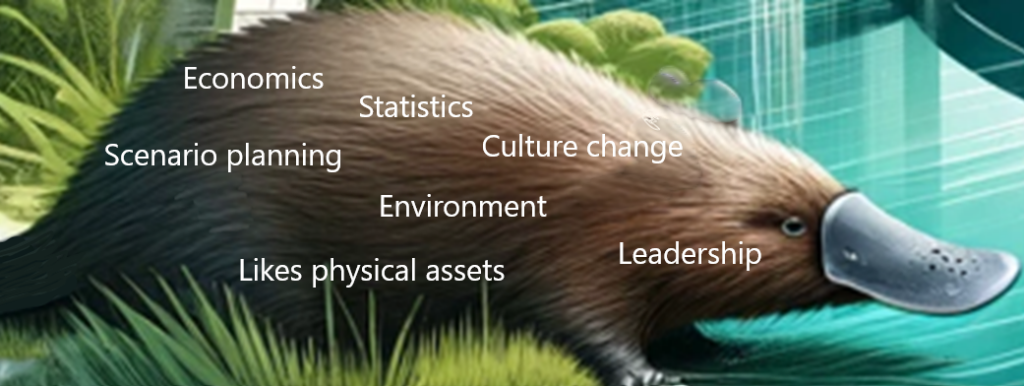
If Asset Management is to deliver better asset planning, we have a challenge. Are we living up to it?
The most obvious thing about AM is that it’s about physical assets. And for most of its history, the assumption has been that the main quality of an asset manager is that they need a background in those areas most concerned with physical assets: that is, engineering, operations, or maintenance.
Who else knows or cares about physical assets? And without that interest, AM might be unmoored: a branch of finance or corporate planning that simply doesn’t know or care enough.
The dilemma is that we need other skills that don’t come for free with delivery backgrounds.
Worse, we need perspectives that definitely go against what we learn in engineering school, or the motivation of operations.
- How do we nurture a profession of people who really like the realities of physical assets but think in a new way about them?
- How early do we need to reach potential asset managers?
There are some good signs – Dr Monica Beedles’ Street Smarts and Biz Smarts, for example, and the Canadian Network of Asset Managers (CNAM) work on AM competences. (And shout out to pioneers of new ways of getting to undergraduates – hello, Valerie Marcolengo!)
But, as CNAM points out, we have a chronic shortage of asset managers.
And many who struggle in post without the tools of effective asset management planning.
How do we reach those with the environmental, analytical, process, culture change and bigger picture skills we need?
What is your ideal undergraduate syllabus to grow the next generation of asset managers?
Thanks to the British Columbia South Island AM Community of Practice for the opportunity to discuss competences this week!
Now that we have a great many courses and various trainings in asset management it is tempting to say that all asset managers should be ‘qualified’. But thinking about this I reflected on my own experience, starting from nothing, and I also remembered an interesting dinner one night when a colleague reported that his daughter had an ambition to be an asset manager like him.
“You can only do what I do, if you do what I did” replied her father, explaining that his daughter would need to do an engineering degree and further study as he had done.
“Is that really true?” asked his wife, who had home-schooled their extremely bright children. “Could she not learn by observation and questioning and work her way up from simple to more complex tasks? That is the way she has learnt everything else!”
You and me and, indeed, many asset managers have learnt much of their asset management this way. It is only within the last ten or fifteen years that we have started to teach the processes and techniques of asset management – in seminars, workshops, and in formal education.
Some of you would have a graduate degree in engineering, others would have come up through a background of construction, maintenance, finance, or property development/ management and may, or may not, have formal tertiary qualifications.
A couple of the best asset managers I have known had qualifications — but in nursing! One became Director of Capital Works in a Health Commission, the other an extremely practical policy director in the Commonwealth Government. They really understood the concept of service.
Or consider the Asset Manager I lunched with, who designed and published much sought after practical guidelines in asset management, decision making and life cycle costing, all without the background of a formal degree – just an inquiring mind, the interest to read widely, and the wit to apply what he read. He was, moreover, able to teach these techniques to others who also had no formal training and to design policy that encouraged their use. Now that IS an Asset Manager!
When we consider the number of excellent engineers we know, great at ‘doing’ things, but with little real interest in decision-making, then we would have to conclude that an engineering background may be useful but it is neither necessary nor sufficient.
“But surely we have to have properly qualified people?” Sure, but how do you qualify people to look for better ways to do what has always been done, indeed, better ways to do what they, themselves, have been taught to do? Qualifications and ability are not synonymous. We need to be more flexible and mandating certain qualifications or training will only hinder flexibility.
So yes, keep learning, get qualifications, but in a fast changing world, no set of qualifications can be allowed to be a stopping place. Or to stop us

What makes an effective asset management practitioner? Ruth Wallsgrove ,who founded IAM’s Asset Magazine in 2004, recently contributed this opinion piece to the magazine in which she shared some of her experience in working around the globe. Our thanks to IAM for permitting reproduction here.
On the steering group to review the IAM Competences Framework, we discussed the distinction between the things we needed to know about and things we actually have to be able to do for ourselves. That is between what we need to appreciate other people doing, and what we have to take main responsibility for.
A useful way I have found to think about asset management capabilities generally is: what won’t get done if we don’t do it? What key competences should we expect not to be there, if we don’t have them?
This means areas such as IT, Engineering and Finance are fields we should understand, but we don’t necessarily need to have hands-on skills or previous experience in them. There are plenty of other people, other professionals, looking after them.
On the other hand, we have to be the ones to understand good asset management practice, and to communicate this and its benefit across our organisations. Who else could do this? Communication, facilitation and change management of attitudes are often called ‘soft’ skills, but that doesn’t reflect how hard many of us find them in practice.
Information and risk
I have become increasingly interested in in two other areas vital for effective asset management that we cannot depend on anyone else to know how to do. They probably are not there anywhere else in our organisations, especially as applied to physical assets. And they are not in any sense ‘soft’.
First of all, we need to ensure we have the skills to understand what information about our assets can and cannot tell us. This isn’t about IT, data collection or even quality assurance, but about interpreting data. The realm of data science, including statistics, is crucial here. Some of the best asset managers I’ve worked with have exceptional data-analysis skills – some even teach data science at college or have backgrounds in military intelligence. Once you’ve seen a true expert in action, it’s clear that asset management is incomplete without these skills. (It’s a shame that many of us didn’t enjoy statistics in college!)
A second, related area of concern is risk management. The whole realm of managing physical assets has up to now been – well, how can I put this delicately – naive about risk. We still struggle to quantify risk, as if actuaries didn’t exist. The basic issue may not just be that we have been ignorant (and I am talking about myself here), but that we’ve been positively resistant to handling uncertainty.
Embracing uncertainty
Twenty years ago, Ype Wijnia from ProGas in the Netherlands alerted our community to the problem of relying on people who don’t like to work with uncertainty On those whose previous education, and maybe natural preference, leans towards knowing for sure, or relying on rules to give the right answer.
But that just isn’t asset management, it’s all about making decisions and planning for the future. The one thing you can be sure about is that you don’t know everything. You can’t know everything.
We have to ‘embrace uncertainty’, as Chris Lloyd, who previously chaired the IAM work on competences, put it – and use the tools and concepts for managing risk that have been there for years in other professions.
Looking across these key competences, i suspect we’ve relied too much on the skills that individuals bring across from engineering or finance. We’ve lingered too log in our old comfort zones. We should not expect that what we have learnt from previous education and experience is adequate on its own.
We should expect any asset manager to go on learning and exploring areas that may be quite different to what we’ve done before. New tools, new concepts, jumping happily into the unknown.
Curiosity may well be the most important asset management competence of all.
Recent Comments