
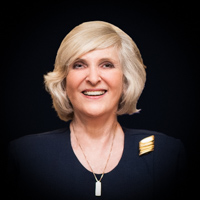
Today, to mark the 10th Anniversary of Talking Infrastructure (and my 85th birthday), we are re-launching the original amqi.com website as Penny’s Place. Permanent links to Penny’s Place can be found in the menu under Resources.
When I closed SAM in 2014 after 20 years, I retained the amqi.com website. For many years, it served only as a signpost to the newer Talking Infrastructure website. But two years ago we started re-creating it, restoring all 400 SAM issues, and as many of the original AMQ issues as we still had access to
In 1984, I began publishing my policy and practice newsletter for Asset Managers to share all that I was learning with others. It started with the Asset Management Quarterly, but within just a few years, it had become the fortnightly Strategic Asset Management. Now, anyone who has published fortnightly will know that searching out and writing on new ideas is completely absorbing. I loved it.
However, with the launch of ISO 55,000, and the recognition and adoption of AM by many engineering associations, both here and overseas, it was time for me to change direction. So, in September 2014, I published the 400th and final issue of Strategic Asset Management. For that issue, I asked many of those who had contributed to its pages over the past twenty years to write where they saw AM going in the future. I called that bumper issue “The Beginning”, because our future is always just beginning, although for me it felt more like an end.
In SAM, you will recognise many of the key names from that period across Australia, New Zealand, the UK and Canada. The stories are drawn from the three levels of government, the military and the private sector.
My new direction was to create the Talking Infrastructure Association. This organisation focuses on applying what we have learnt from Asset Management to make decisions that genuinely develop infrastructure ‘fit for people and the future’. Talking Infrastructure opened in 2016, and is going strong a decade later.
Then, in 2023, to ensure we do not lose sight of our origins, I wrote ‘The Story of Asset Management’. This book describes the birth of Asset Management, its struggles and growth over its first ten years, and provides illustrative stories showing how people reacted to the introduction of a new science. This took the story up to 1994, by which time the idea of AM was rapidly spreading. In March 1994, I started the newsletter to support new Asset Managers; in 1996, I created the International AM Competitions to encourage them; and in 1998, I launched amqi.com, a website covering all levels of asset management and free to all.
I aim to add a little more each month. As I re-read the earlier work, I find myself re-invigorated by the energy of that time, and I hope you will feel some of this too.
Please enjoy, Penny.

The Board of Talking Infrastructure wants to thank Penny – wants to make a big, big fuss over Penny – for the immensity of what she means to us and to Asset Management.
All of us had our lives and careers changed by Penny. Without her, we wouldn’t be calling ourselves asset managers, for a start. We are doubly blessed that she is also a great friend to each of us individually.
I first knew of Penny when another important AM person in my life, David Ford, came back from a trip to Australia and New Zealand in 2001 clutching a copy both of the International Infrastructure Management Manual and an issue of Penny’s Strategic Asset Management newlsetter. Saying there were some things we therefore would not have to make ourselves, and anyway could never have done so well.
I already was sure when I met Penny in person in 2004 at ICOMS we would be fast friends, going to stay with her and Bob in Adelaide on the MESA ‘eminent speaker’ tour that summer. My life certainly was never the same after that, as the next year I went back to work with her on a job for NSW Rail Corps… and the year after to live in Sydney. Where she and I could plot some more, ending up eventually with Talking Infrastructure itself.
Of course, the price I paid for her continuous inspiration was knowing I would always been running to catch up – sometimes several large steps behind her thinking. But that was always so much fun.
One thing I am most proud of is spreading her words around North America, making sure new assets managers knew who she was and her vision for infrastructure Asset Management. She has quite a fan club of younger women around the globe, including the USA. I would like to claim I am fan #1, but there are many pioneers in the queue ahead of me.
Talking Infrastructure would like to publish your memories and appeciation of Penny. When did you first come across her? Where did you take the ideas she inspired?

125348823 | Our History © Jakub Krechowicz | Dreamstime.com
More than a decade ago, Penny Burns set up an AM history group in LinkedIn. Her idea was firstly to collect people’s own stories, of how they came to be involved in Asset Management.
Last year Talking Infrastructure published Penny’s own history, of how she came to create Asset Management in 1984 and her first decade working with it. (The Story of Asset Management.)
From when AM really took off in the 1990s, it’s much harder to collect all the strands, and the stories include many other people. That’s why volume two of the history would look very different.
I am still fascinated by the personal journeys – not least because it brings out what distinguishes AM from other disciplines (why do people leave engineering, for example?)
I also have things when I teach about the wider history, but these really come from the people I have met, that I have happened to meet. And what I remember of what they said twenty or twenty five years ago, that they may not even agree with (or remember in the same way).
And the internet, even with AI, doesn’t cover most of it. We erase it when we rewrite a website, unless we consciously refer to what came before (or look up old sites in an archive project). I cannot find that old LinkedIn group, even though I don’t think anyone actually removed it.
Perhaps it’s natural that some only really think about history, and legacy, as they come to the end of their working lives. When you first meet a topic like Asset Management, you just know it’s there, not where it came from.
But it seems to me that asset managers ought to be interested, because we must have a good sense of time and change to do our jobs. “If you don’t know your history, you don’t know where you’re coming from,” as Bob Marley nearly put it. Understanding what’s happened before is the base material for having any sense of what may happen next, in ideas as well as deterioration curves.
Volume 2 is not yet a project. But Talking Infrastructure is planning longer articles on key topics such as planning and risk, and how to mine SAM newsletter material. Not the final word on anything, probably, but the next word, or part of the picture. A resource that can help us remember.
Watch this site for some more notes on our collective history.
And share your own story and memories of how it evolved for you.
Just a reflection on our own institutions.
I have been involved with the IAM on and off for almost 25 years. I attended Asset Management Council meetings and conferences (under different names) when I lived and worked in Australia in the 2000s. I have been impressed by the IPWEA since someone brought back a copy of the IIMM to the UK around 2001. My boss was instrumental in setting up the GFMAM.
These are just the most obvious AM institutions. (But shout out to Canadian AM networking here, too.)
They have not always been particularly friendly to each other, but at roughly 30 years old at their oldest, we seem to have developed some institutional maturity.
I was heartened to realise that, for all its limits – well delineated by Richard Edwards and others at the recent IAM UK conference – the revisions and new ISO 55000 documents involved hugely more people this time around.
The IAM itself has grown and now functions in more European and Asian countries, as well as succeeding in the USA; it has a truly excellent CEO in Ursula Bryan. I love the IPWEA ‘Ask Your Mates’, the kind of practical support we need from out networking.
But perhaps the best sign of all was a workshop last month on ‘Peak Infrastructure?’. A room full of Asset Managers asking what infrastructure we really need. And how there is work still to be done to make a lasting difference. Changing national government policies not to incentivise (or give in to developers and construction companies) building new when we can maintain what we have.
All physical assets come at a cost, often a very steep one in impact on the environment and communities. We have to take the lead to make sure we understand costs versus benefits.
That’s the real question when we get together as Asset Managers.
*IAM: Institute of Asset Management, HQ in UK. IPWEA: Institute of Public Works Engineering Australasia. GFMAM: Global Forum on Maintenance and Asset Management, established by the IAM, Asset Management Council and others. Asset Management Council in Australia. Canadian Network of Asset Managers, plus Provincial AM networks such as AMBC and AMOntario.
At this end of 2024, I am more convinced than ever that the whole point of Asset Management is Planning.
Planning, as opposed to delivery – which we have been doing for decades, if not centuries. Asset Management is about thinking through what we need to deliver across our asset base, Plan before Do. (Don’t just do something, sit there.)
That is what Penny created Asset Management for.
And the central concept was lifecycle modelling, supported by cost-risk-optimisation, matched to understanding demand. When is the right time to replace, renew, maintain? What don’t we need to do?
The AMP has been the centre of Asset Management since the very beginning. As captured in state and federal requirements, as documented in the International Infrastructure Management Manual from the IPWEA.
We need Planning – and it is not going to happen without us.
But it is too often still – after 40 years! – fragmentary, driven by vested interests (even the understandable wish by people on the ground to get money for their own assets).
It doesn’t look at what happens next: ‘And then what?’
And I can count the organisations I work with that actually do lifecycle cost modelling or cost-risk optimisation on the fingers of two hands.
To do the maths on all the major costs, risks and benefits of different options across the lifecycle, and demonstrate that (for example) building back rural roads like for like after they have been washed away for the fourth time in five years simply doesn’t add up.
Time for a Campaign for Honest Asset Management Planning?

I have just been to the 30 year celebration of the Institute of Asset Management (IAM) in London, where we also marked ten years of ISO 55000. This was held jointly with the Global Forum on Maintenance and Asset Management (GFMAM) – representing AM and AM-minded maintenance societies worldwide – with representatives from IPWEA and the Asset Management Council. A time to reflect as well as celebrate!
Russ Seiler of Grant Public Utility District (one of the Columbia River hydro utilities in the Pacific North West) reflected on his journey since 2016. Starting from scratch as an Asset Management lead, under Russ the team at Grant has looked at asset inventory, Wave 1, and the absence of basic asset data. It then focused on the AM ‘system’, as in ISO 55000, and the idea of building AM artefacts. (Wave one-and-a-half?) But, encouraged by Penny’s 2023 book on the beginnings of AM, he realised that neither were really the point.
His conclusion after seven years? “If your asset management program never affects the money being spent on assets, your program should and will be terminated.” AM creates the machine that produces the plan, a better plan for the assets. Everything else is just a means to that end.
It’s the AMP process, ok.
I have trained many 1000s in the last 14 years, in the USA and elsewhere. And that’s what I have found, too. Too many get caught up in asset data – which is important, sure – and documents such as the AM Policy and SAMP, which are also important. But that is never what Penny meant by Asset Management.
And ‘plan’ doesn’t just mean what proactive maintenance you should do, or what you need to spend capital on to sustain your existing asset base. It’s also what if any new infrastructure we require. It’s whole of life and system-wide. It’s big.
Have we been tinkering at the edges while the world changes around us?
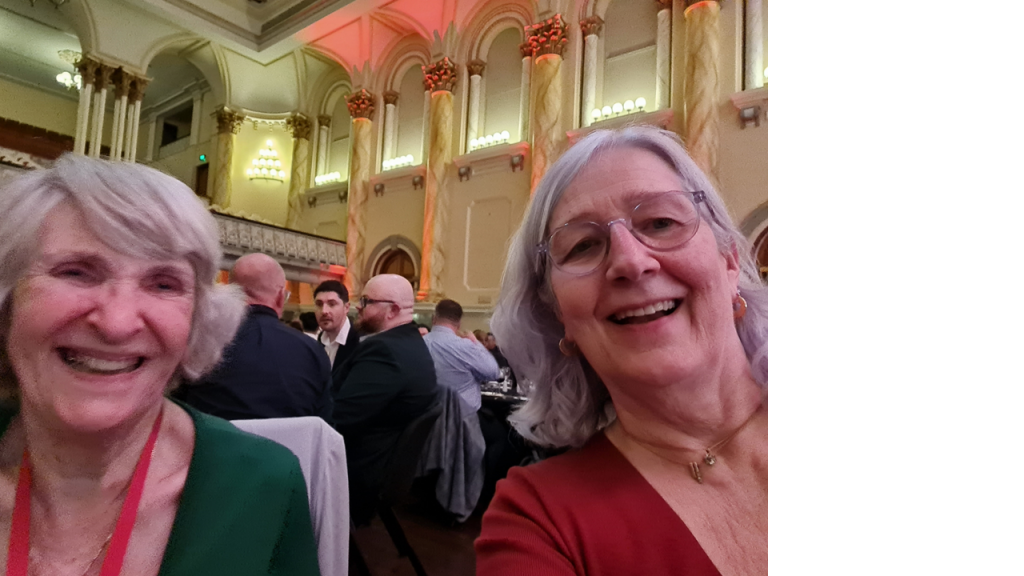
Penny and Ruth at AM Peak gala dinner, April 16 2024
Since I last posted I have spent a month celebrating 40 years of Asset Management in Australia with Penny, Jeff and Gregory; gone to one of my favourite conferences in Minneapolis; taught an advanced AM course to some sophisticated AM practitioners in Calgary, as well delivering to as a post ISO 55000 certification client in California.
I have been thinking about where AM needs to go next, at the same time as worrying that things have not moved far enough.
And it just keeps coming back to: We Need to Raise our Game. And not because what Penny kicked off four decades ago hasn’t made a huge difference already.
But I want us to do more.
First, to effect what Penny set out to do through Talking Infrastructure: to look up and out, to make a difference to key decisions on what infrastructure we really need.
Secondly, as I start to unwind from delivering basic AM training – something I have loved doing for nearly 14 years now – I reflect on our competencies.
This kicks off a series of questions and reflections on what we want to change, and how to do it.
How to interest existing AM practitioners in upskilling on risk, data analysis, culture/ system change, persuasion, strategic thinking?
How to find people who want to challenge the status quo on infrastructure projects?
What can we best offer from our collective experiences to support better decision-making?
I am looking forward to this!
Come and meet Penny and Talking Infrastructure in person! Watch this space for additional details, but here’s the programme so far:
April 15 & 16 AMPeak, Adelaide. Penny and Ruth will be at AMPeak.
April 18, Stantec, Brisbane
April 19, PACoG, Brisbane. Asset Institute, QUT, 11am- 12.30, followed by lunch. Join Joe Mathew and Kerry McGivern along with Penny and Ruth to discuss what we’ve learnt in 40 years – and look forward to the next 40. Includes a look of what is happening with asset management internationally, in this big year for AM.
April 23, Blue Mountains City Council, Katoomba, 10am to noon. Seminar with Jeff Roorda on Blue Mountains City Council planetary health and disaster recovery experience, plus update on the new advocacy project underway by IPWEA Roads and Transport Directorate (IPWEA RTD – NSW/ACT), on Lessons Learned from Disaster Recovery, to assist NSW Councils work with Local, Strate and Federal Government Agencies.
April 24, Sydney event, Dawes Point. 6-10pm Harbour View Hotel, 18 Lower Fort Street, Dawes Point, NSW 2000. Using the recent experiences of the Blue Mountains City Council, Talking Infrastructure is holding an event in central Sydney to call for urgent changes in all of our asset mindsets and tools to ensure planetary health, biodiversity and climate change resilience. Meet with Penny, Jeff, Gregory and Ruth, plus local IPWEA. Food provided thanks to AMCL.
April 30, IPWE, Melbourne. Presentation by Penny. Penny and Ruth will be at IPWE until May 3. There will also be a dinner out in Melbourne for TI friends and colleagues – please let us know if you would like to join us. And bring along your copy of Penny’s book to get signed!
If you are planning to attend our Sydney celebration, please RSVP to: amis40@talkinginfrastructure.com so we can keep an eye on numbers – limited to the first 60! Event is free, includes food and discussion with Penny Burns and Jeff Roorda and a whole heap of old friends and colleagues.
Full update of the 40th year celebration events shortly!
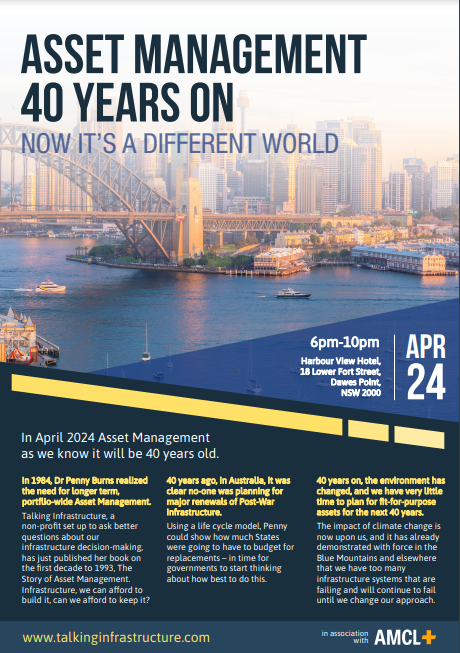
Join us at the Harbour View Hotel in the Rocks and help celebrate with finger food and drinks – plus Penny and Jeff on what we have learnt from the last 40 years to help us meet the challenges of the next 40.
Many thanks to Richard Edwards, Lynn Furniss and Matt Miles of AMCL
Recent Comments