

The peculiar antics of Elon Musk in late 2022 prompts, once more, the question of whether tech billionaires are really the best model for our heroes.
During Covid, plenty of people realised how dependent we are on carers, paid perhaps a millionth of what Musk pays himself. We clapped for a very different kind of heroics during lockdown.
Infrastructure is an intriguing mixture: it’s technology to keep our societies going, not primarily to make money. Managing it well involves caring for stuff. We are not carers in the traditional sense – and many of us are paid better than nurses or teachers.
Of course, technology innovation and looking after other people are very heavily gendered in our society: stereotypically, techies are male, carers are female. Making an obscene amount of money from exploiting innovation is masculine heroics; working till you drop caring for someone else is feminine heroics. (There are plenty of men in caring professions, but that doesn’t stop the stereotype.)
Sometimes I feel we’re trying to work out what kind of heroes we want to be in asset management. There are plenty who fancy the innovation techie route, getting all excited about ‘digital transformation’ (cf. the call this week for papers by ReliabilityWeb on the subject, for example) and, probably, the well-founded belief this is an easier way to make money. There are others, more equitably spread between women and men, who are sure it’s mostly about people.
We shouldn’t be particularly surprised to see crude stereotypes echoed in our own profession. A colleague recently described the problem of dominance in AM by “fat middle aged white men” (he said he was talking about himself, and the fat bit was a joke) – a dominance that doesn’t thrill me. I find myself more alarmed by the failure to learn our own lessons about what it takes to manage infrastructure, and rush into anything techie. As though, this time, technology innovation will sort out all the problems. Including the tiresome need to think about people.
But, then again, it’s surely the mix, the dynamic tension, between technology and caring which actually appeals to many of us; that brought us into asset management in the first place.
In their excellent book The Innovation Delusion, Lee Vinsel and Andy Russell challenge both innovation and heroes as ideals – and propose instead the maintenance mindset and how to sustain our “human-built world”. I think this is partly what they mean, this interesting mix.
PS Their Maintainers are still going strong, by the way, with some assistance from the Alfred P. Sloan Foundation and the Siegel Family Endowment – see www.themaintainers.org
In May 2018, Penny Burns and Jeff Roorda wrote here about three ‘revolutions’ in Asset Management – later renamed ‘waves’, because that captures better the idea that one wave doesn’t supersede another.
Since then, we have discussed with each other and many others how Wave 1, ‘Asset Inventory’, is more successful if you already have in mind the vision of Wave 2, ‘Strategic Asset Management’ and how you are going to use all of the information you collect.
We have looked at what Asset Management practitioners need to develop to move on from this, to be able to look beyond our own organisations, to a bigger role in supporting our communities. We called this Wave 3, supporting better ‘Infrastructure Decision Making’.
We have even begun to imagine Wave 4.
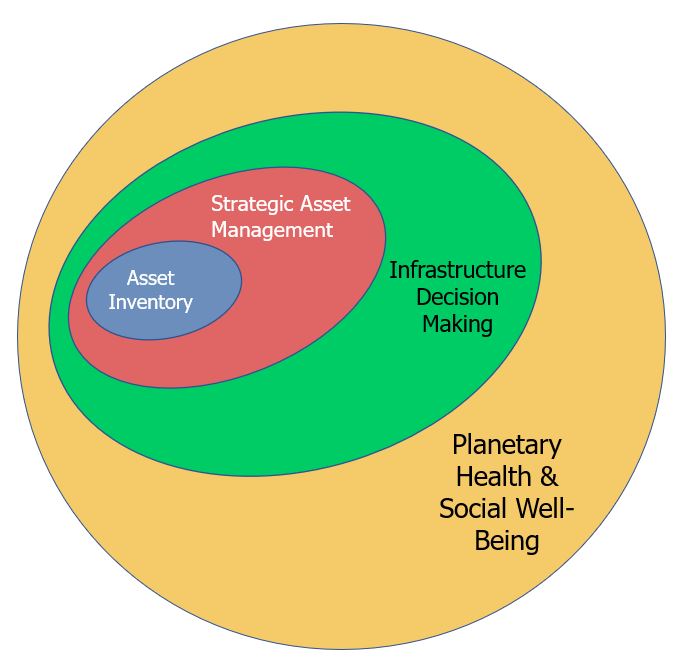
As Penny puts it: whereas Wave 1 looked at WHAT we had, and Wave 2 looked at HOW we needed to manage it, Wave 3 started to ask WHO we were serving by our efforts. This has brought us now to start thinking more deeply about this question and about the next move, looking at the critical question of WHY.
As Asset Management practitioners, we have to ensure we are in the right positions of influence to be able to challenge existing infrastructure assumptions, which is what I think Wave 3 is all about. To look ‘up and out’, as Lou Cripps of RTD puts it.
But we can already spot that there is no point in being able to ask hard questions, if we don’t have the right questions to ask….
What do we mean by ‘better’?
Recent Comments