
This is a follow-up to Julie’s and my first post. This comes from discussions with Ruth, as we are both fans of Kuhn and approaching Asset Managment from a Systems Thinking bend.

Asset Management isn’t failing, but it is struggling. It’s struggling because it asks for something most organizations aren’t ready to give: a change in worldview.
In his seminal work The Structure of Scientific Revolutions, Thomas Kuhn argued that progress in science doesn’t move forward in smooth, logical steps. Instead, it lurches forward through upheaval.
An existing model, what Kuhn calls a paradigm, organizes how people understand and act in the world. When that model starts to break down under the weight of anomalies it can’t explain, a crisis forms. Eventually, a new model takes hold. Not by refining the old one, but by replacing it entirely.
Asset Management isn’t a toolkit upgrade. Asset Management is a paradigm shift.
The prevailing paradigm in many organizations see assets as cost centers. Value is measured in terms of budget variance, performance is gauged by how fast we respond to failure, and success means keeping operations running despite broken systems and shrinking resources. This is the logic of firefighting, not foresight.
Asset Management offers a radically different frame. It suggests we treat assets as value-producing systems. These decisions should be based not only on today’s conditions but on long-term impacts. That success means reducing failure, not merely reacting to it quickly. And that the ultimate responsibility of an organization is to deliver reliable, sustainable service—not just to manage budgets.
But here’s the problem, and Kuhn would recognize it: paradigms don’t go quietly. The existing mindset fights back. Asset Management is often taken in and translated through the old lens. We say we’ve adopted Asset Management, but we’re still rewarding short-term fixes. We talk about lifecycle value, but we still plan one year at a time. We build dashboards and risk models, but we still defer investment until failure forces our hand.
This is normal. According to Kuhn, when a new paradigm first appears, it doesn’t make sense within the old logic. People struggle to see its relevance. They may accept some of its tools, but not its worldview. The old questions remain, and the new answers seem off-topic.
Real change happens only when the organization starts asking new questions. Not just, “How do we save money this year?” but “What will this decision cost us over the next 30?” Not, “How fast did we respond to the outage?” but “Why did the outage happen at all?”
That’s when a shift begins.
A true Asset Management transformation doesn’t begin with data, or systems, or even leadership mandates. It begins with discomfort, when the old paradigm can no longer explain the failures piling up around us. When firefighting becomes too exhausting, too expensive, too visibly ineffective. Then, and only then, do people become open to a new way of thinking.
So, the task isn’t just to implement Asset Management. It’s to create the conditions where the old worldview can be questioned. That means:
- Telling stories that expose the cost of reactive practices
- Measuring success in ways that reward foresight
- Giving voice to people who see the long game
- Protecting Asset Management from being reinterpreted as just another compliance exercise
Paradigm shifts are hard. They are political, cultural, and emotional. But they are also the only way real progress happens. Asset Management doesn’t need to fight harder. It needs to be ready to lead when the cracks in the old system finally become too big to ignore. It needs to be there to offer a better forward.
Link to Ruth’s article: AM, Capital-ism and Shifting Paradigms | Talking Infrastructure
Julie and I produced this after a recent discussion with Ruth. I think it’s a discussion we’ve been having for years.
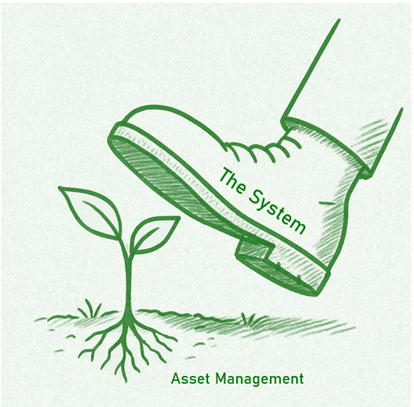
Todd Shepherd & Julie DeYoung
Once upon a time, or so the story goes, Asset Management started to take sprout at our organizations with a bold promise. It came to guide us toward long-term thinking, to help us look beyond next year’s budget and into the decades ahead. It came with principles and frameworks, a philosophy that assets are not isolated items, but interconnected parts of a whole. The decisions we make today shape the quality of life for future generations. It was a different way of seeing how investing in the right place, at the right time, could save money, and public trust.
But then Asset Management met The System. And The System did what it always does: it absorbed the new idea and bent it back into something familiar.
Instead of being a strategy for long-term stewardship, Asset Management became a new label for what we were already doing. We turned it into a more refined version of the same habits: squeezing the last bit of life out of aging assets, reacting quickly to failures, and deferring investment until the next crisis hit. We framed these actions as efficiency, as cost savings, as smart business. But they were just survival tactics. And so, when Asset Management started to bloom, it was quietly, subtly, reshaped.
What was meant to be transformational became transactional.
Long-term planning? That would have to wait. We needed to fix the latest failure, explain the recent cost overrun, patch the emergency before the news cycle caught wind. The capital planning calendar was full of yesterday’s fires. Asset Management was drafted into service as a better way to react.
Rather than change The System, Asset Management was absorbed by it. It was translated into the language of short-term cost savings and immediate returns. “Get more life out of your assets” became a directive, not to optimize lifecycle value, but to defer replacement as long as humanly possible. And The System applauded. Budgets tightened. Work orders increased. Failure response times improved…until they didn’t.
This isn’t a failure of individuals. It’s what happens when a new idea runs headlong into The System. The System reward firefighting over fire prevention. It promotes leaders who solve today’s crises, not those who quietly prevent tomorrows. It allocates resources to what is visible, immediate, and politically expedient. And so, Asset Management is quietly reshaped until it fits.
A discipline focused on resilience and long-range value becomes a sophisticated way to do what we’ve always done: squeeze, stretch, defer, and repeat.
Asset Management, instead of being a disruptor, became domesticated.
The truth is, Asset Management requires a paradigm shift. It requires a new way of thinking about value, responsibility, and time. It asks us to see past short-term wins and start building for long-term resilience. It asks leaders to stop managing symptoms and start addressing root causes. It asks organizations to measure success not by how fast they respond to failure, but by how rarely failure occurs at all.
That’s a hard shift to make. It means unlearning habits, changing incentives, and having the patience to invest in what won’t pay off this quarter. It means making space for new voices, new metrics, and sometimes uncomfortable truths.
But if we want Asset Management to be more than a buzzword, we need to protect it from the status quo. We need to give it space to grow before we ask it to perform. And most of all, we need to let it change us before we change it.
To do that, leaders must become designers of systems, not just managers of outcomes. They must ask: What behaviors are we rewarding? What stories are we telling? Are we building a future, or just managing decline?
Asset Management didn’t fail. It simply wasn’t given a chance to take root. But the story isn’t over. It’s still being written. And if we’re willing to change the system, we might just change the ending.

Image from James Webb Telescope: Interacting Galaxies
After taking three months off – impressed how much surgery slowed me down! – I am taking stock.
I find I am almost totally not interested in Asset Management as a technical subject. Or rather, that I have no hope that something technical (like ‘AI’) will sort it for us.
And yet, there is still a large problem to be sorted, that surely requires new, and clever, thinking.
The Talking Infrastructure board is more or less convinced that we have not yet made Asset Management stick. In particular, to get where Penny saw 40 years ago: business as usual longer term planning to meet infrastructure demand. And more recently, planning ahead in a changing world.
One painful example is the retreat from meaningful AMPs in Australian councils, their first home.
Why infrastructure organisations don’t face the future has been a puzzle. Vested interests, for example in the construction industry, sure; lack of skill or vision in the decision-makers, yeah. Is it basically that the pain of not planning adequately doesn’t fall on the people failing to plan?
Our inability as a species to think beyond a few years?
But I am not yet that pessimistic. I don’t believe it’s biological.
What most grips me is the problem of culture. Yes, we happen to live in a peculiarly short-termist culture. But let’s, as clever people, tackle it as a Meadows-type system challenge.
In the past decade some of us have asked how we can get an organisation to plan sustainably: to have a process, a system to plan out our assets, that outlives any CEO, or any individual asset manager for that matter. A few years ago, a network of us in North America looked at how to ensure that an incoming CEO took an AMP process as given. Useful and entrenched enough not to be their focus for change.
Did we succeed anywhere?
Watch this space…
From script by Lou Cripps
What’s the responsibility of Asset Management? In my mind, there’s no question.
The output from an effective Asset Management system is a better allocation of resources to physical assets. It’s all about allocating $ and people where they are most needed, and not to spend or do where that is not needed.
And that can mean only one thing. AM – the system, not the team – should be the major input to the budgeting process for asset-intensive sectors such as power. And a major input wherever there is a significant amount of budget at stake.
The Asset Management input to the budgeting process is what Penny originally called the AMP. Given that ISO 55000 didn’t quite get it, I wonder if we should now spell it out – the asset management planning process (AMPP). One integrated, co-ordinated process that looks across the whole asset base with consistent principles on which to base decisions about priorities for the medium and long term.
We should expect – hope, indeed! – that this will over time have a major impact on business budgeting. That asset-related budgets will change significantly when we have a more optimising system, to make better use of information and plan further into the future.
The focus is not individual decisions, but the wider decision processes.
- What are the priorities for asset renewals, that is major work to replace or refurbish assets?
- What is the appropriate level of planned maintenance to optimise cost, risk and performance?
- Given the current state of the asset base, what is a realistic level of allocation to reactive work going forward?
- How do any growth or new assets fit within the overall strategy (and how important are they in relation to sustaining the assets/ services we already have)?
And this is not planning just about the physical assets. Both the money and the resources have to be considered: there is little point in arguing for money if there is not also a realistic plan for the people to deliver the work.
If we agree this is what Asset Management has to deliver, that also tells us what the main job of a dedicated AM function is and its key relationships with other functions. We can work through what kind of skills and capabilities we require, and where AM sits in the organisation.
It’s why I don’t consider Asset Management in any sense a sub-branch of Engineering – or the capabilities what we teach on current engineering degrees. It’s also not Finance, or HR, or Procurement, though it involves all of these.
And the bigger the amount of dollars at stake, the more vital that we do good Asset Management.
Talking Infrastructure is looking again at the AMP and the asset planning we require for future-friendly infrastructure. If you would like to be involved, contact us!
From script by Lou Cripps
Sometimes, it feels too much to do it all step by step.
Most organisations I work with don’t yet have any asset plans beyond five years. Some still only have annual budgets. How do you add in changing requirements for the longer term if you don’t even ask past five years?
And how many years ago did asset managers realise you can’t plan if you don’t think about where you want to get to? (At least 20, because strategy comes before planning in BSI PAS-55 published in in 2004.) But almost no-one has properly strategic ‘asset strategies’. They literally don’t know where they want to take their assets.
Bit by bit – and maybe getting nowhere fast.
But there is an alternative, maybe. Can we describe a compelling vision of where we want to be, first?
Can we even leapfrog some of the gradualist things we currently do?
Gradualism may be personal preference, or professional training. We haven’t always been bold about our mission. Some of us are detail people.
How would it be if we really believed we have a duty of care to make a big difference to the, frankly, fairly dumb way we’ve conventionally managed infrastructure?
Todd Shepherd and Julie DeYoung describe this as a system thing. What we have is a system, or paradigm, which resists change – so tinkering at the edges doesn’t work, because the old system will just bounce back as soon as you stop pushing.
This is, of course, quite a different concept of ‘system’ from the parts and pieces idea of a ‘quality management’ approach such as ISO 55000, which instead encourages a bit by bit, start with AM policy or SAMP. Better than thinking the first step has to be IT – but possibly no more ‘sticky’.
Quicker, and less heartache, to go for undermining the whole thing with strategy and long-term planning from the start?
Recent Comments