

From script by Lou Cripps
The lifecycle-based Asset Management Plan was Penny’s solution to the issue of short-term thinking.
In particular, she wanted us all to look ahead at budget requirements for renewals – replacements and refurbishments of aging assets.
But planning and lifecycle thinking are needed for other challenges, too.
For me, the fundamental point is the importance of thinking ahead. Of being proactive rather than reactive, of exploiting what we already know about our assets to stop being surprised by things we can work out ahead of time.
In a week when many of us are trying not to think about WW3, we know we don’t know everything about the future. But we need to make better use of what we do know.
The problem, 40 years on, is that so many organisations don’t.
Here are just some of the questions I would wish – fairy godmother style – everyone to be able to give better answers to.
- 101, if we think we need to build some new infrastructure asset, what will it cost to maintain and operate it?
- What are the different realistic solution options – and what opportunities will we lose in choosing any of them?
- What’s the evidence that we have understood the problem and scoped our preferred option correctly? What else has to be considered in with the capital cost – like the cost of new facilities when we buy new electric fleet, for example?
- What costs and disbenefits should we also cost into the materials we choose, such as embodied carbon or damage to other communities?
- What costs and disbenefits will continue long after the physical asset is gone (think the loss of species or habitats, long-term damage to communities)?
- Do we really have any fact basis for the costs, risks and benefits of something new, as opposed to sustaining what we have?
All of these are elements of whole life cost modelling. Too bad many organisations still don’t even use basic lifecycle costs for their budgeting or strategies.
The underlying problem… is a system that doesn’t plan for the future. Is it lack of the right skills in the right place, or vested interests? Laziness??
One thing I am pretty sure is that it isn’t a lack of available information.
What do you think: just how bad, on a scale of 1 to 10, are our current infrastructure business cases?
Further good reading: Penny’s Infrastructure: we can afford to buy it, can we afford to keep it? Louise Hart, Procuring Successful Mega-Projects: How to Establish Major Government Contracts Without Ending up in Court. Joseph Berechman, The Infrastructure We Ride On: Decision Making in Transportation Investment.
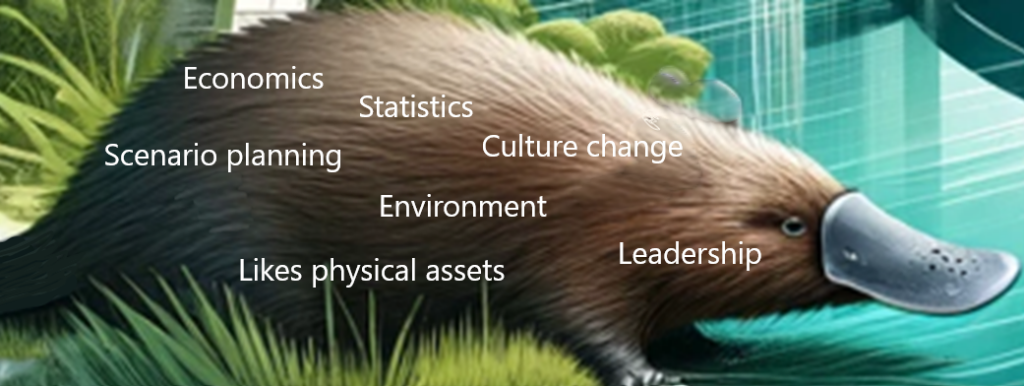
If Asset Management is to deliver better asset planning, we have a challenge. Are we living up to it?
The most obvious thing about AM is that it’s about physical assets. And for most of its history, the assumption has been that the main quality of an asset manager is that they need a background in those areas most concerned with physical assets: that is, engineering, operations, or maintenance.
Who else knows or cares about physical assets? And without that interest, AM might be unmoored: a branch of finance or corporate planning that simply doesn’t know or care enough.
The dilemma is that we need other skills that don’t come for free with delivery backgrounds.
Worse, we need perspectives that definitely go against what we learn in engineering school, or the motivation of operations.
- How do we nurture a profession of people who really like the realities of physical assets but think in a new way about them?
- How early do we need to reach potential asset managers?
There are some good signs – Dr Monica Beedles’ Street Smarts and Biz Smarts, for example, and the Canadian Network of Asset Managers (CNAM) work on AM competences. (And shout out to pioneers of new ways of getting to undergraduates – hello, Valerie Marcolengo!)
But, as CNAM points out, we have a chronic shortage of asset managers.
And many who struggle in post without the tools of effective asset management planning.
How do we reach those with the environmental, analytical, process, culture change and bigger picture skills we need?
What is your ideal undergraduate syllabus to grow the next generation of asset managers?
Thanks to the British Columbia South Island AM Community of Practice for the opportunity to discuss competences this week!
From script by Lou Cripps
What’s the responsibility of Asset Management? In my mind, there’s no question.
The output from an effective Asset Management system is a better allocation of resources to physical assets. It’s all about allocating $ and people where they are most needed, and not to spend or do where that is not needed.
And that can mean only one thing. AM – the system, not the team – should be the major input to the budgeting process for asset-intensive sectors such as power. And a major input wherever there is a significant amount of budget at stake.
The Asset Management input to the budgeting process is what Penny originally called the AMP. Given that ISO 55000 didn’t quite get it, I wonder if we should now spell it out – the asset management planning process (AMPP). One integrated, co-ordinated process that looks across the whole asset base with consistent principles on which to base decisions about priorities for the medium and long term.
We should expect – hope, indeed! – that this will over time have a major impact on business budgeting. That asset-related budgets will change significantly when we have a more optimising system, to make better use of information and plan further into the future.
The focus is not individual decisions, but the wider decision processes.
- What are the priorities for asset renewals, that is major work to replace or refurbish assets?
- What is the appropriate level of planned maintenance to optimise cost, risk and performance?
- Given the current state of the asset base, what is a realistic level of allocation to reactive work going forward?
- How do any growth or new assets fit within the overall strategy (and how important are they in relation to sustaining the assets/ services we already have)?
And this is not planning just about the physical assets. Both the money and the resources have to be considered: there is little point in arguing for money if there is not also a realistic plan for the people to deliver the work.
If we agree this is what Asset Management has to deliver, that also tells us what the main job of a dedicated AM function is and its key relationships with other functions. We can work through what kind of skills and capabilities we require, and where AM sits in the organisation.
It’s why I don’t consider Asset Management in any sense a sub-branch of Engineering – or the capabilities what we teach on current engineering degrees. It’s also not Finance, or HR, or Procurement, though it involves all of these.
And the bigger the amount of dollars at stake, the more vital that we do good Asset Management.
Talking Infrastructure is looking again at the AMP and the asset planning we require for future-friendly infrastructure. If you would like to be involved, contact us!
Recent Comments