

ID 26212151 | Child In Shallow © Pavla Zakova | Dreamstime.com
When we look back at the history of Asset Management, there is one curious feature.
In a world in which many people go on about data, many act like the revolution of AM is the discovery of asset data.
Why?
Penny many years ago made the point – well, that the point is making better long-term decisions about assets. Wave 1, ‘asset inventory’, only has any value when we use such data to make better decisions, in Penny’s Wave 2: strategic asset management. As Penny says, when you focus on the decisions, you have a much clearer idea of what data you actually need. Wave 2 improves Wave 1.
But there must be some kind of reason why organisations seem to have to go through Wave 1, collecting and organising data, first.
Cynically, we might think it’s because it’s easier than questioning decision-making: something middle level asset managers can do without challenging business at the top level. Or, and/or, there are plenty of suppliers willing to sell you help in collecting data or implementing the transactional IT systems to put it in. Few that actually know how to make better decisions.
But I come to suspect that, weirdly, asset-centric data is more radical than it sounds. What suggests this is how hard other teams kick and scream about collecting and handing on asset inventory, the very basic data on what assets we have where. (Capital projects, IT, even some maintenance teams.)
It doesn’t seem to help to stress that we cannot manage what we don’t know we have. Is the problem that they don’t understand that we do have to continue to manage assets into the future?
Or is it – back to basics – that the whole concept of an asset is the first revolution?
Other people manage projects, budgets, sites, even value on the balance sheet. Only Asset Management believes the fundamental unit of management is the operational asset.
Can we rewrite the advice on implementing Asset Management to get us to decisions faster?
Are too many organisations still not making that very first leap into the water?

Memorial to Jules Verne, Amiens, ID 381624172 © Linda Williams | Dreamstime.com
One way to put my life in context is: when I was born, Robert Heinlein was king of science fiction.
Not that I knew this until ten or so years later, when I started to read my family’s collection of sci fi Penguins. We, naturally, also favoured British writers, who, if not noticeably more female or non-white, were at least less American gung-ho.
Now, the world of the future is very different, with some ‘non-binary’ writers, Afrofuturism, and radical ecologies. And good aliens, my favourite.
Between then and now, there have been a lot of post-apocalyptic dystopias, which I tend to keep away from. Post-scarcity anarchism is much more my thing (see Ursula K LeGuin, and Iain M Banks’ ‘Culture’, for example).
And hope.
If one defining feature of good Asset Management is developing longer term planning, and infrastructure urgently requires a future vision, can hopeful science fiction help us?
What’s your most inspiring example of a fictional future?
And a vision of future infrastructure?
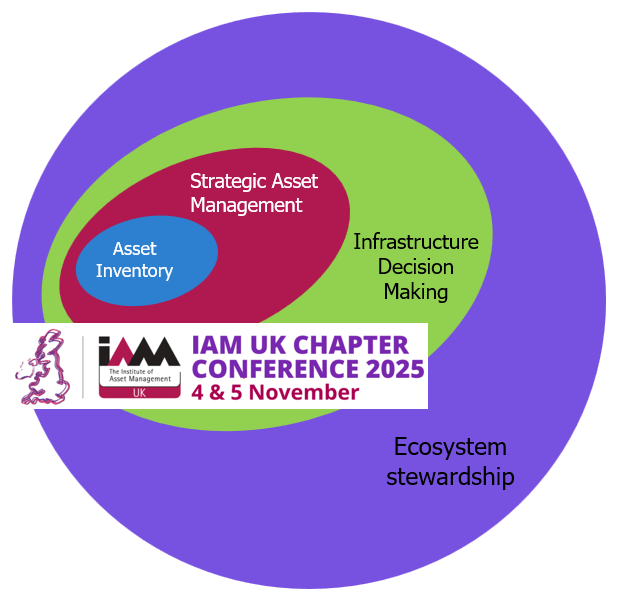
Just after Penny Burns and Jeff Roorda wrote about the revolutions or ‘waves’ of Asset Management in 2018, I realised how useful this was for surviving Asset Management conferences.
Sitting through yet another presentation about asset data, I thought: too many of us are still stuck in wave 1, asset inventory. Oh, for more papers on wave 2 and actually using information for making better strategic asset decisions! It’s not just my problem!
I had the great pleasure of attending a conference this month when not only did I not sit through anything on data, BIM, digital twins or AI, but we actually looked forward to waves 3 and 4.
The IAM UK conference, curated by Ursula Bryan – I really have to give her the credit – including an AM professional talking about how to use AM to solve Cape Town’s infrastructure challenge. That is truly wave 3 looking up and out. And another presentation about using AM to redefine coasts: a vision of wave 4.
At the conference I only addressed wave 2 with my US AM mob, about how most organisations still have to implement lifecycle based longer term planning.
But it was fantastically heartening to put this in the context of more ambitious Asset Management. Shout-outs to Johannes Paradza of Infrastructure Asset Management South Africa, and the always visionary Joe Inniss and Ashley Barrett of their Centre for Asset Studies!
See ‘Amphibious Infrastructure’, https://www.centreforassetstudies.co.uk/articles
Recent Comments