
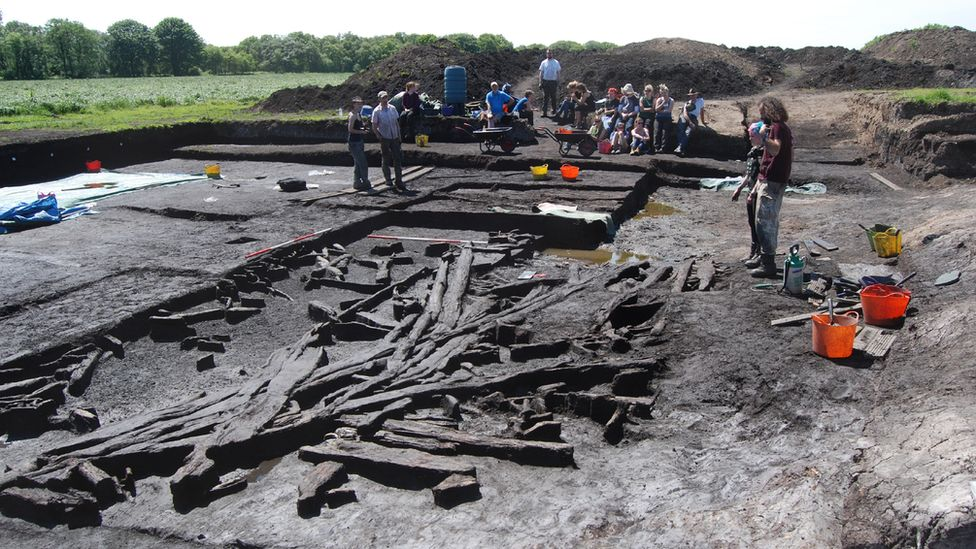
Excavation at Star Carr in Yorkshire, bbc.com
If I had the brain capacity, I’d write a book called something grandiose like Infrastructure and Civilisation. To bring out just how important working infrastructure is to us.
You can’t have ‘civilisation’ – people living in towns and cities – without it. How did it grow, from the earliest actions to build shared causeways? We are handy, but it must be more than that.
I just read an interesting book called Inheritance: The Evolutionary Origins of the Modern World. It’s by Harvey Whitehouse, an anthropologist who also conducts psychology experiments on small children and co-compiled a database of hundreds of cultures already studied by anthropologists and archaeologists to analyse for key factors – as I said, interesting.
It made me reflect that both modern society and physical infrastructure require two things: co-operation between people (to build and maintain far larger social and physical structures than one person or even family could do) and sanctions, in other words ways to get people to do, or not do, things.*
Both have their origins well before homo sapiens, of course. Primates are largely social co-operators – and have strong views of what’s not fair, that they will go out of their way to punish. Sanctions for anyone not behaving well don’t have to involve written laws or dedicated police: for a social animal whose life depends on co-operation, disapproval works well on its own.
I grew up with a just-so story about competition being the motive force of progress, but it is much, much more interesting to look at how people work together.
It’s certainly my experience of infrastructure. 99% co-operation with some rules and regulation to force social-mindedness where necessary.
(And my current read is Progress, A History of Humanity’s Worst Idea!)
What’s the required balance of co-operation and rules for sustainable infrastructure?
*Whitehouse talks about why slavery did not in the end work out – why it’s more effective to get people to co-operate, when you grasp our basic psychology.

30199342 | Happy © Michal Bednarek | Dreamstime.com
They say you should not have favourites among your children. But I found it impossible not to have favourite clients.
I always enjoyed some individuals, some asset managers in particular. More than being nice people – which they were – it was about understanding each other, speaking the same language. Many others I worked with over 30-plus years simply didn’t get what we were saying.
In another lifetime, I would love to figure out why I warmed to some regions more than others: why I loved asset managers in Indonesia, Malaysia, some Canada, west coast USA – and New Zealand, of course.
But favourite clients also include organisations run by the more visionary executives.
I did not always get near the C suite, or councillors. But my fondest working memories now are for those who were engaged. Taking me back to almost my earliest discussions about Asset Management change, about what is and is not possible unless there is a CEO who gets it.
Sometimes there were executives who almost got it, and those are not such happy memories. Some of them even know who they are, because I got to the point when I said this out loud, that they were not succeeding at Asset Management because of the bizarre choices they made. That they were the problem.
Happier to think about how much is possible if the top guys get it.
As opposed to industry sectors which believe in rapid turnover of CEOs who don’t stay around long enough to care about longer term plans.
Makes me think the ‘high reliability’ thinkers got it right about commitment.
How much real improvement on Asset Management is possible unless there is long-time leadership that cares?

I always taught that the international standard ISO 55000 was a milestone achievement for the profession of Asset Management when it was published in 2014. A consensus across many sectors and countries, when it’s clear not everyone sees the same things in AM.
It’s really about AM as a quality management system – do what you say, say what you do.
And it does acknowledge the issue of senior management, the decisions makers – the importance of leadership actively supporting the management system.
However, plenty of organisations have not felt a great need to be certified against it, even if it addresses basically sensible management practice.
I want to think about two aspects of this.
First, they don’t need certification because it’s not anything they feel especially held accountable for. A couple of bodies, such as Ofgem the UK power regulator, have considered making it a legal or licence requirement, but have been resisted.
Second, even if it were in some way enforced, it doesn’t address big decisions. Somehow, it doesn’t say anything about how an organisation, or a government, decides to spend millions on an infrastructure project – how to avoid wasting the money, or anything they should do after they have a failed project on their hands. It doesn’t really address budgeting at all.
It’s pitched at middle management processes. Yes, lower asset decisions need to be aligned with overall organisational goals – and in some way signed off by top management.
But about the decisions top management makes itself, not so much.
I am not asking for an amended standard in ISO terms. More something like higher standards in public service (and infrastructure is always a service to communities, even when controlled by commercial companies).
What should we do instead, in addition?
- How to get the organisations themselves to think more carefully about their big, long term decisions – it that possible through internal audit-type mechanisms? (Such as, are they following their own asset strategies and long-term planning and budgeting processes?)
- And how much do we, the public, need more formal mechanisms like third party audits, and tougher regulators, to hold them accountable for how they make the big money infrastructure decisions?
What can we, as Asset Management professionals, as middling managers, do about this?

39167631 | Cartoon Teeth © Tigatelu Dreamstime.com
Why do so many organisations not have good long term plans for their assets? Why don’t they stick to their Asset Management strategies?
Being continually sucked back into short term reaction is one problem for infrastructure (and the more political the sector – such as transit – the worse it is).
And forgetting. New CEO, new CFO, someone coming in that simply hasn’t thought about what they are managing. Good Asset Management isn’t built into the furniture, the basic business processes enough. Someone ignorant of AM comes in and doesn’t even know what they are abandoning.
The need for tighter regulation may be, as Lou Cripps has said, just evidence that a sector isn’t doing a good job.
But I am coming to think that mandatory audit – as in government audit offices, or even internal audit enforced by non-executives as part of good governance – may be a key infrastructure AM tool.
Infrastructure, managed on behalf of communities, is too important and too long term not to manage well. Decision makers – whether C suite, councillors, board members – must be held to account for their decisions.
Regulated audit is one practical way to do this. Not simply the kind of quality control envisaged in ISO 55000, more the kind of visibility (and check for legality) of an annual financial audit. Not perfect, but a lot more companies would cheat on their tax without it!
Audit is not judging by results, but checks you did what you said you would do, that you followed the processes that you claim to use. Such as evidence-based budgeting and business cases for investment.
A good decision can still lead to less than good outcomes – but making it well is all we have for the long term.
Scrutiny of the process is particularly important when making decisions for the long term. This requires clarity and sticking to your principles. Being able to demonstrate you know why you made a decision.
I suspect audit with teeth is a natural companion to good longer term, more strategic thinking about our physical assets.
What is your experience of regulation audit in Asset Management?
Recent Comments