
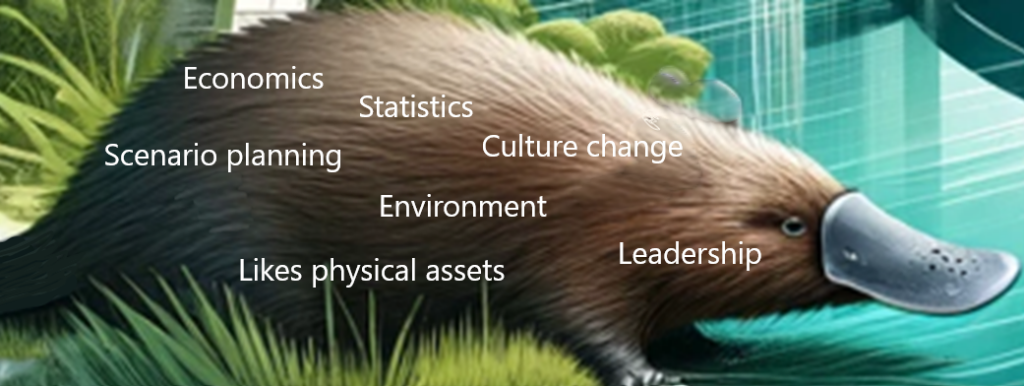
If Asset Management is to deliver better asset planning, we have a challenge. Are we living up to it?
The most obvious thing about AM is that it’s about physical assets. And for most of its history, the assumption has been that the main quality of an asset manager is that they need a background in those areas most concerned with physical assets: that is, engineering, operations, or maintenance.
Who else knows or cares about physical assets? And without that interest, AM might be unmoored: a branch of finance or corporate planning that simply doesn’t know or care enough.
The dilemma is that we need other skills that don’t come for free with delivery backgrounds.
Worse, we need perspectives that definitely go against what we learn in engineering school, or the motivation of operations.
- How do we nurture a profession of people who really like the realities of physical assets but think in a new way about them?
- How early do we need to reach potential asset managers?
There are some good signs – Dr Monica Beedles’ Street Smarts and Biz Smarts, for example, and the Canadian Network of Asset Managers (CNAM) work on AM competences. (And shout out to pioneers of new ways of getting to undergraduates – hello, Valerie Marcolengo!)
But, as CNAM points out, we have a chronic shortage of asset managers.
And many who struggle in post without the tools of effective asset management planning.
How do we reach those with the environmental, analytical, process, culture change and bigger picture skills we need?
What is your ideal undergraduate syllabus to grow the next generation of asset managers?
Thanks to the British Columbia South Island AM Community of Practice for the opportunity to discuss competences this week!
From script by Lou Cripps
What’s the responsibility of Asset Management? In my mind, there’s no question.
The output from an effective Asset Management system is a better allocation of resources to physical assets. It’s all about allocating $ and people where they are most needed, and not to spend or do where that is not needed.
And that can mean only one thing. AM – the system, not the team – should be the major input to the budgeting process for asset-intensive sectors such as power. And a major input wherever there is a significant amount of budget at stake.
The Asset Management input to the budgeting process is what Penny originally called the AMP. Given that ISO 55000 didn’t quite get it, I wonder if we should now spell it out – the asset management planning process (AMPP). One integrated, co-ordinated process that looks across the whole asset base with consistent principles on which to base decisions about priorities for the medium and long term.
We should expect – hope, indeed! – that this will over time have a major impact on business budgeting. That asset-related budgets will change significantly when we have a more optimising system, to make better use of information and plan further into the future.
The focus is not individual decisions, but the wider decision processes.
- What are the priorities for asset renewals, that is major work to replace or refurbish assets?
- What is the appropriate level of planned maintenance to optimise cost, risk and performance?
- Given the current state of the asset base, what is a realistic level of allocation to reactive work going forward?
- How do any growth or new assets fit within the overall strategy (and how important are they in relation to sustaining the assets/ services we already have)?
And this is not planning just about the physical assets. Both the money and the resources have to be considered: there is little point in arguing for money if there is not also a realistic plan for the people to deliver the work.
If we agree this is what Asset Management has to deliver, that also tells us what the main job of a dedicated AM function is and its key relationships with other functions. We can work through what kind of skills and capabilities we require, and where AM sits in the organisation.
It’s why I don’t consider Asset Management in any sense a sub-branch of Engineering – or the capabilities what we teach on current engineering degrees. It’s also not Finance, or HR, or Procurement, though it involves all of these.
And the bigger the amount of dollars at stake, the more vital that we do good Asset Management.
Talking Infrastructure is looking again at the AMP and the asset planning we require for future-friendly infrastructure. If you would like to be involved, contact us!

44169003 © Shea R Oliver | Dreamstime.com
Regulation can be an admission of failure – failure of a sector to do what it should do.
And the realisation that many organisations only take Asset Management seriously because some branch of government tells them they must can seem like our failure, failure to convince them AM is for their own benefit.
And some stop doing it when they are no longer pushed…
What incentivises someone in a position of some power in a public agency to do the right thing? More particularly, what encourages them to think longer term?
CEOs and other senior managers have several kinds of short-term incentives: personal annual targets and maybe bonuses. Local politicians with their own short-term ambitions for re-election. Immediate approval or disapproval from their communities.
Public-sector managers can pick up assumptions about their careers from the private sector. Moving onward and upward by moving organisations – or moving on before anything catches up with you.
On the other hand, whatever their views on their own careers, people in government regulations are normally set the objective of improving the efficiency and effectiveness of what they are regulating over time.
Of course there are poor regulations, and poor regulators. One urgent concern is governments depriving regulators of teeth and funding to enforce the regulations – the UK Environmental Agency’s ability to enforce the law on sewage releases into rivers, for example.
But overall, their incentives are far more aligned to longer-term Asset Management than the average manager. They realise they can’t change things overnight, that it’s about processes and competences and a longer-term perspective. The regulators I have known are generally firm, but patient. They know they have to be.
Infrastructure is too important to be left to ambitious executives alone.
Are we working closely enough with the regulators?
From script by Lou Cripps
Sometimes, it feels too much to do it all step by step.
Most organisations I work with don’t yet have any asset plans beyond five years. Some still only have annual budgets. How do you add in changing requirements for the longer term if you don’t even ask past five years?
And how many years ago did asset managers realise you can’t plan if you don’t think about where you want to get to? (At least 20, because strategy comes before planning in BSI PAS-55 published in in 2004.) But almost no-one has properly strategic ‘asset strategies’. They literally don’t know where they want to take their assets.
Bit by bit – and maybe getting nowhere fast.
But there is an alternative, maybe. Can we describe a compelling vision of where we want to be, first?
Can we even leapfrog some of the gradualist things we currently do?
Gradualism may be personal preference, or professional training. We haven’t always been bold about our mission. Some of us are detail people.
How would it be if we really believed we have a duty of care to make a big difference to the, frankly, fairly dumb way we’ve conventionally managed infrastructure?
Todd Shepherd and Julie DeYoung describe this as a system thing. What we have is a system, or paradigm, which resists change – so tinkering at the edges doesn’t work, because the old system will just bounce back as soon as you stop pushing.
This is, of course, quite a different concept of ‘system’ from the parts and pieces idea of a ‘quality management’ approach such as ISO 55000, which instead encourages a bit by bit, start with AM policy or SAMP. Better than thinking the first step has to be IT – but possibly no more ‘sticky’.
Quicker, and less heartache, to go for undermining the whole thing with strategy and long-term planning from the start?
Recent Comments