

from script by Lou Cripps
Just a thought about current Asset Management practice.
One core tool used by many is the maturity assessment or gap analysis. See, for example, the Institute of Asset Management’s SAM+ tool.
The concept here is to audit an organisation against a standard, recognise its shortfalls against that standard, and recommend actions to close the gaps – in an implementation plan often referred to as the Asset Management roadmap. The standard could be ISO 55000 series, or perhaps more usefully the 39/now 40 subjects in the GFMAM Asset Management Landscape.
ISO 55000 has some oddities (don’t get me started here on the terms ‘SAMP’ and ‘asset management plans’), but the involvement of far more people in the revision in 2024 probably makes its coverage more realistic.
The problem with the world of AM assessments and roadmaps isn’t fundamentally which topics we assess.
It’s that we simply don’t take our own principles seriously.
Alignment with organisational objectives is surely the key organising concept in ISO 55000. And yet we still propose AM implementation against standards – rather than our corporate priorities.
We also have a history collectively of ridiculous outputs, roadmaps that detail 70 or 130 different actions, for AM teams of perhaps 2 or 3 people to implement in the next 2 years – as though we had no experience, no common sense of what it’s like to implement major change. Almost as though we aren’t taking the AM Landscape ‘red box’ Organisation & People into account at all.
In Asset Management, there isn’t a ‘right’ way to do everything. That’s engineer talk. The optimal way forward is the best realistic option for us, for where we are now, for what our organisations are trying to achieve.
Sure, there are some things which are probably always a bad idea to do, and some that are usually good. But it’s not about a set of rules. Not a template we can fill in, leaving our brains in a jar somewhere.
Whatever we call it, a top-level strategy for Asset Management is essential. But it only makes any sense as a case for how AM will contribute to our organisational targets and challenges. And the practical actions that will do most to support the overall business strategy.
Yeah, the answer is almost always going to be a better planning process for our assets.
But if we start by taking something from inside AM, like ISO 55000 or GFMAM 40 Subjects, and use that as a basis to propose priorities for implementation, we are doing what asset people have too often done before.
Ignoring the business priorities. Not being aligned, right from the start.
Instead, the first thing is to make sure we really understand the organisational challenges, by talking with the people at the top. They won’t always be crystal clear, but that’s the right terrain to start with. Perhaps we’ll even be able to assist in articulating the challenges.
Then talk about what we can realistically do with AM to meet them.*

The gap assessment we require is the gap between what AM could usefully do for our organisation and what we are actually achieving at the moment.
*In my mind, there is very little chance that the corporate priorities for infrastructure won’t require good Asset Management, urgently. We are definitely not at risk of talking ourselves out of a job.

From script by Lou Cripps
Bad news for techies, but infrastructure is mostly money, business and politics.
Yes, Asset Management is about making better decisions on our physical assets. But not just any decisions: the wider, longer-term, strategy and co-ordination that organisations struggle with.
Operations already take care of immediate responses. Engineers are more than happy to focus on the technical details. Finance counts the money – but struggles to do more because it doesn’t get the honest information about the assets that it needs.
The gap that Penny Burns identified in 1984 was, first of all, planning for capital renewals to maintain the infrastructure base we already have, beyond the next year. A need most people didn’t even notice, let alone take on to fill.
In the forty years since, Penny has talked extensively about decisions for new infrastructure as well. About how the overall system needs to change to meet changing demands for service. And the impact of physical assets on the economy, the environment, our communities.
In other words, Strategic Asset Management.
In the past few years I have been asked to develop webinars and other support for better asset strategy and planning. My fundamental message is A. Strategy and planning are not the same, and B. they are complementary, and we need them both.
Over the next few weeks, we’d like to explore them both further. Starting with understanding why organisations are so bad at them.
- Asset Management planning is about the allocation of budget and resources. It therefore has plenty of opponents who only care that their own projects and assets get the money.
- Asset Management strategy requires standing back to think strategically, which many people (including CEOs) are not good at doing.
- There isn’t a formula, or a template. There are good questions, but some of them are hard, and many of them require saying no to some things, and some people. Not going along with the political clamour for simplistic solutions.
- There are vested interests – some of it bordering on corruption (who will make money from this decision?) And more who feel challenged on how they have done things in the past. Even on what they were trained to do.
What are your experiences of asset planning? What works – and what gets in the way?
Is any of it really a technical problem we can solve at our desks?
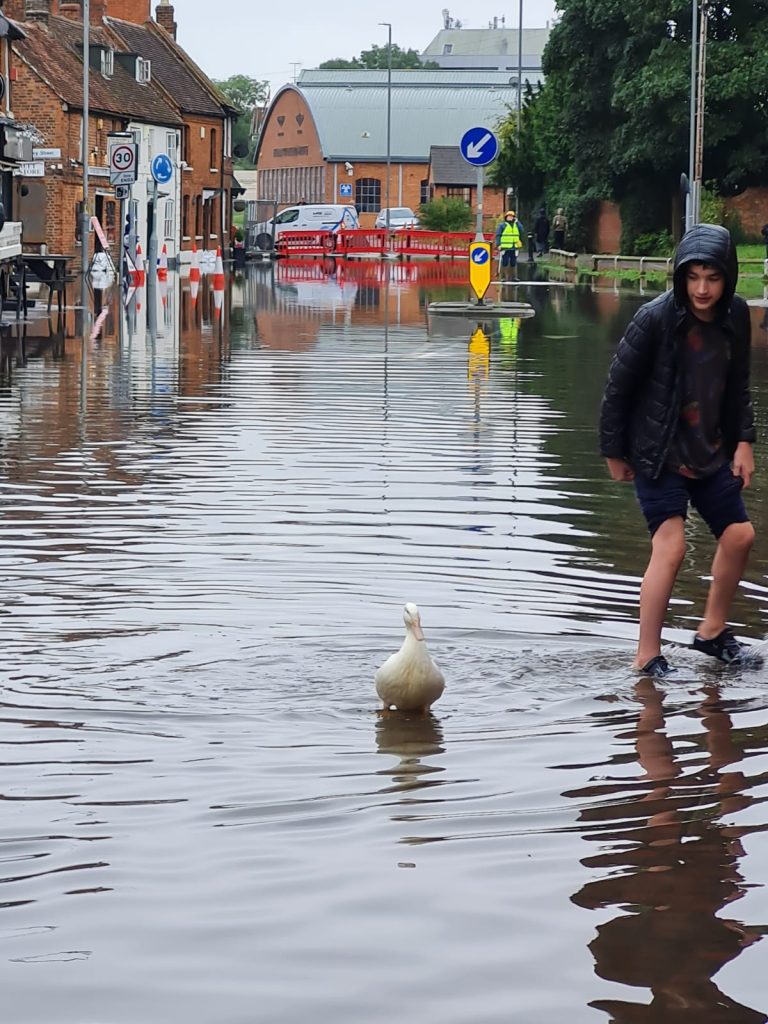
At least the pet duck enjoyed it
When we moved into our house, we first realised the problem when the mortgage company said we needed flood insurance, and discovered that would cost ten times the normal building and contents policy.
Until a smarter insurance company here sold us a cheaper policy based on postcode (in other words, by group of two or three houses), not Environment Agency flood areas: they spotted a market opportunity for a more precise risk assessment. Smug us!
Until six years later, and the house actually did flood.
And four years on, in late 2024, the water came to our front door twice, and overtopped the sand bags the second time.
And the risk of flooding in England is predicted to increase five-fold in the next decades under current projections for global warming.
However, Newport Pagnell is not Miami.
To be clear, our flooding is due to rain, and living next to where two rivers meet. Unfortunate timing of river surges – or someone getting the timing off on floodgates. We are nowhere near the sea and don’t get hurricanes, and so far the extent of our flooding is a few inches of water at the front of the house.
A few houses flooding a bit: you start thinking about resale values, and whether getting wet every year or so will do the brick walls and wood floorboards any good.
In South Florida, they face losing whole towns to the sea and the swamps. Many people live only a few feet above current sea levels, and the infrastructure is similarly low and at risk. They have to worry about overwhelmed sewerage systems and nuclear power plants.
Florida has such a tax-averse politics that it will come down to money for school education versus money for flood action soon for some towns. They continue to build right up to the sea and in areas only just above sea level, even as they watch the hurricanes track towards them. And of course the ruling Republicans also mostly deny climate change.
It would seem a perfect storm of human inability to face the facts.
But it is striking just how much of an issue it is for infrastructure. And that involves use of tax dollars, national insurance schemes, building codes, politics and Politics: so much more than simply technical questions.
Do we speak the right language/s to manage this?
Recent Comments