
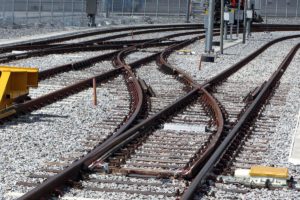
Switch (courtesy Falk2)
If we have information that can lead to better decisions, can we fail to act? Can we excuse ourselves with “it’s their job”, “not my responsibility”, “I don’t want to be involved”.
Philippa Foot devised a thought experiment in 1967, routinely called the “Trolley Problem”. The experiment involves a train (trolley) heading toward 5 workers. The train is a runaway and all 5 workers will certainly be killed if nothing is done. There is a side track with only one worker and you are in the right place at the right time to make a decision. You can activate the rail switch, diverting the train and resulting in a single certain death. Or not. There is no time to alert the workers, or gain assistance; the train can’t be stopped.
As a tool to teach ethics this particular experiment is deceptively simple, should I sacrifice 1 to save 5? It does however raise numerous questions, “am I obliged to act?”, “do I have a duty?”, “is interfering wrong?” “do I act morally or ethically?”, “do I act for the greater good, the good of the people involved, or for myself?”
This dilemma is very long lived and has captured the imagination of the professionals and public. There are many variations – is it Ok to stop the train by pushing someone in front of it? What if that person was responsible for the runaway train? What if the workers could be saved by sacrificing a bystander, or a loved-one?
When anyone is faced with making a decision at a switch they can make a moral choice, an ethical choice, a popular choice, and when making that choice they can include longer time frames, wider consequences, how the action will make them feel, how others will think of them.
Questions today: When it comes to infrastructure decision making, when our decision takers are standing at the switch, how do we know if we should contribute to the conversation? When would we join in if we do, and with what level of action?
 The value of “value management”, as Mark Neasbey, Director of the Australian Centre for Value Management, has illustrated in each of his previous posts, is in challenging what we think we know. In “The Power of ‘What if?'” he reveals how questioning a ‘given’ led to a radically different solution and a saving of hundreds of millions of dollars. Mark writes:
The types of things that are generally in a list of givens include:
- a law or regulation that has to be complied with;
- a technical performance requirement – be it a range or a set minimum or maximum number or a specific number – which can represent dimensions, volumes, rates and so on;
- a limiting boundary or barrier or a technical constraint;
- financial – e.g. an amount not to be exceeded or specified sources of funding, interest rates and so on;
- ownership and operating arrangements;
- authorities and delegations;
- a specific time or date that the asset is required or to be disposed of; and
- application of a particular process or corporate policy.
[Not an exhaustive but just some main examples.]
Now the thing about such givens is that we develop our options or solutions accepting these, rather than challenging them. So they tend not to come into creative thinking processes, accept as a limitation. Yet what happens if its not really a given, rather it turns out to be possible to change it – even if only to treat it as an assumption?
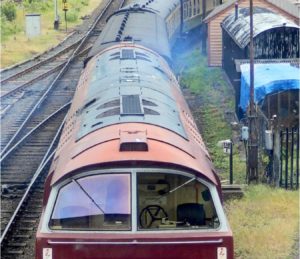
A recent rail project to develop expanded train maintenance and stabling facilities began with a given that the existing mainline was fixed – it could not be changed. By not allowing it to be moved the project solution involved some complex and expensive engineering and infrastructure to manage the train movements into and out of the depot, which are planned to eventually have headways as short as 30 seconds. [Driverless trains.] There was also an effect on how the layout of the expanded facility could be realised – it was not going to be as ideally efficient as possible to operate.
During a value engineering review however, the effects of not moving the mainline to the engineered solution became clearly a cause – not of concern – but for a better appreciation of the opportunity forgone to create a simpler, more elegant engineered solution and at a huge cost reduction.
The mainline alignment had been stated as a given by the client early in the planning process. So all of the initial feasibility work and preliminary concepts evolved based on that given. What subsequently emerged in the value engineering review was that this arose from a decision not to acquire a particular developed property adjacent to the line.
By asking the simple question “what if…?” the team was able to show a much better outcome was possible – not only at a lower capital cost, but with significant long term reduction in maintenance and operational risks to the network.
Two important highlight lessons to me are:
- Do you have an understanding of what is being labelled or taken as givens for your assets and asset strategies?
- Do you have a process to all testing and challenging of such givens so decision-makers are aware of their implications?
The Task today: An answer to either of Mark’s questions OR an example of a positive ‘What if?” challenge of your own.
Recent Comments