
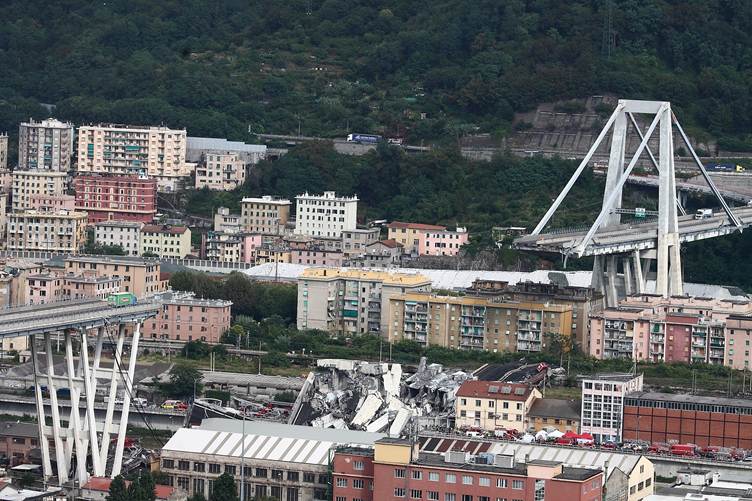
Morandi Bridge Collapse © Valerio Bianchi | Dreamstime.com
The collapse of the Morandi Bridge in Genoa, Italy, in 2018, was a spectacular infrastructure failure. And immediately blamed on lack of maintenance.
43 people died – and now 57 people have been prosecuted for failure to maintain, among other charges.
I was intrigued at the time, because though bridges do collapse, it’s not usually blamed on maintenance. But it is a typical issue for long-life assets, to put off repairs to save money; the point about long-life assets with slow deterioration is that people cross their fingers and hope collapse won’t happen on their watch.
In this case, it appears that nothing was done to address detectable rust in structural steel cables. To see there is rust, and not to act, is if anything even more negligent than not to inspect for rust.
Was it lack of maintenance, or poor design?
I don’t feel much sympathy with the defence argument: those who maintain and operate should surely attempt to understand if there are design issues, and it hardly matters once you can see the rust. (What do you think?)
Charges were laid against engineers, government officials and senior managers. It took almost four years of investigation before the case came to trial, another four years for the trial, and more than 280 hearings. Was it really that technical? I suspect an awful lot of defence buck-passing, and the delay took it beyond their statute of limitations for some of the charges.
This week the former head of the motorway operator was given a 12 year prison sentence, and we can only hope it does encourage the others.
Intriguingly he is already serving a sentence from a separate 2013 road disaster….

The Innovation Delusion: How Our Obsession with the New has Disrupted the Work That Matters Most, Lee Vinsel and Andrew L Russell (September 2020)
Is this the first ‘popular’ book on Asset Management & Infrastructure Decisions? You wouldn’t necessarily know from the title.
But maintainers and asset managers are the, well, not heroes here: Vinsel and Russell describe ‘infrastructurers’ as something better than heroes. ‘The people who care about things’, as Lou Cripps puts it. And infrastructure in terms of human rights.
The book is a sustained attack on ‘bright, shiny new things’, especially when they really are not worthy of the name innovation, and when they will land communities in debt and ‘deferred maintenance’ for many years.
“Although you wouldn’t know it from histories that fixate on innovation and inventors, much of human history is, in fact, stories of stability: of how societies coordinate labor to maintain the large-scale public systems we’ve relied on since ancient times.”
But the authors are not simply academics, or popularisers. With Jessica Myerson, the authors have set up The Maintainers, https://themaintainers.org/connect. Their vision is:
“Through collaborative efforts across an interwoven network of communities, we pursue our mission of maintaining self and society through reflection, research, and advocacy in the hopes of achieving a more caring and well-maintained world.”
The book itself is a good read, using the current ‘popular’ non-fiction style of stories around individuals: everything you’ve ever worried about with poor rail track maintenance and failing water systems, and some good people trying to sort them.
I suspect it’s generally true that, when you know the inside story, things are not always quite as simple as written. I was a ‘fly on the wall’ at PG&E over the time of Camp Fire, and I don’t buy that wildfires should be blamed on ‘somebody else’, or one company’s profits alone, for example.
But, with honourable mentions for reliability engineers, Ursula K Le Guin, Melinda Hodkiewicz, and even ISO 55000 – and even computerised maintenance management systems! – this is my kind of territory.
Your reviews of it are most welcome here.
And what do you think about essential infrastructure as a basic human right?
Recent Comments