

Fire Horse © J2 | Dreamstime.com
We have two problems in current Asset Management. They both need change!
Talking with AM practitioners around the place, one issue is that implementing AM as a system, as in ISO 55000, is not sticking – even if it got somewhere in the first place.
AM is literally nothing if it doesn’t make a fundamental change in how we decide what to do to our existing physical assets.
ISO 55000 is remarkable for not being worse than it is, but – looking back – AM is not primarily a quality management system at all. It’s a radically different way to look at the future.
I now believe that’s where we need to start, not an end point.
And this means going straight to the top, rocking the boat, even burning metaphorical and perhaps even actual bridges.
The second issue is that we really do need to make decisions in a different way: the criteria for appropriate assets have moved on since the 1980s. We cannot continue with assets as usual, in the face of climate change, changing demands, and environmental constraints.
What’s heartening in this Year of the Fire Horse is that growing numbers of asset managers agree, through their frustrations. If it doesn’t shake things up – it’s not Asset Management.
We declare: The Year of the Fiery Platypus. Time to change the rules.
Thank you to Diarmaid O Culain for the inspiration!
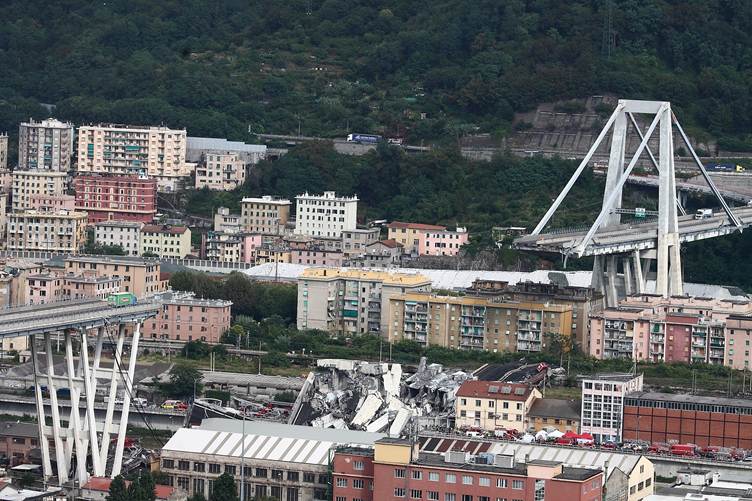
Morandi Bridge Collapse © Valerio Bianchi | Dreamstime.com
The collapse of the Morandi Bridge in Genoa, Italy, in 2018, was a spectacular infrastructure failure. And immediately blamed on lack of maintenance.
43 people died – and now 57 people have been prosecuted for failure to maintain, among other charges.
I was intrigued at the time, because though bridges do collapse, it’s not usually blamed on maintenance. But it is a typical issue for long-life assets, to put off repairs to save money; the point about long-life assets with slow deterioration is that people cross their fingers and hope collapse won’t happen on their watch.
In this case, it appears that nothing was done to address detectable rust in structural steel cables. To see there is rust, and not to act, is if anything even more negligent than not to inspect for rust.
Was it lack of maintenance, or poor design?
I don’t feel much sympathy with the defence argument: those who maintain and operate should surely attempt to understand if there are design issues, and it hardly matters once you can see the rust. (What do you think?)
Charges were laid against engineers, government officials and senior managers. It took almost four years of investigation before the case came to trial, another four years for the trial, and more than 280 hearings. Was it really that technical? I suspect an awful lot of defence buck-passing, and the delay took it beyond their statute of limitations for some of the charges.
This week the former head of the motorway operator was given a 12 year prison sentence, and we can only hope it does encourage the others.
Intriguingly he is already serving a sentence from a separate 2013 road disaster….

ID 6497422 © Hans Slegers | Dreamstime.com
Several of us on the Talking Infrastructure Board will never write an AMP again.
That is, we are retired from paid AM work; but then we already have maybe 150 years of experience of Asset Management between us.
Using the Waves concept created by Penny Burns and Jeff Roorda, we propose two roads ahead for Talking Infrastructure.
The first, working title The Way of the AMP, is to collate and disseminate what we know about Wave 2 strategic Asset Management in useful formats, including Penny’s SAM archives. But we want to do more than capture current practice: we want to challenge and stretch AM practice within infrastructure organisations, including better risk, strategy and information management. People who are still pioneers in this space include Jeff Roorda and Todd Shepherd.
For this we are bringing in more and younger people still developing in their AM careers around the globe to add and challenge.
The second is to go beyond Wave 2, to ask better questions about infrastructure decision-making in our societies. Here, some current AM thinking may be part of the problem, not the solution to the challenges we face in the 2020s.
What are the infrastructure-related issues now? How have they changed since Penny created AM in the 1980s, to deal with problems inherited from the 1950s post World War II?
What does it mean to be a future friendly infrastructure planner in 2026?
Your input, please.

More than a decade ago, Chris Lloyd and Charles Johnson wrote in the Seven Revelations of Asset Management that we must “embrace uncertainty”.
This year we want to build on good practice to help our profession do this.
Let’s cut to the chase: our role as asset managers is to develop plans for the future, and yet the future, even next week, is uncertain. (Particularly at the moment.) We can’t not plan because we don’t know everything. In fact, uncertainty makes it even more essential to have plans.
Chris and Charles were right: we have to leap in.
It’s better to be roughly right than perfectly wrong. And there is no other option. Aiming for certainty is how we would ensure we are adding little value to asset decisions.
Board member Todd Shepherd has worked in North American power and water to develop a better approach to infrastructure risk and uncertainty, based on good practice in other professions and sectors. It’s not about a new tool, not software, but a more fundamental understanding of what managing uncertainty requires.
It requires not even trying to get a perfect answer.
Because the cost of perfect information is infinite – impossible. And good decisions don’t need it. What’s needed from us is practical ways to reduce our organisations’ uncertainty.
We’re currently drafting a much longer piece about how we make better decisions through better estimating and grasp of probabilities. And how it is, in the end, easier to deal with uncertainty than some of the weird things we do in infrastructure at the moment.
Are you in with us?
(We’d love to hear from you on risk.)

ID 26212151 | Child In Shallow © Pavla Zakova | Dreamstime.com
When we look back at the history of Asset Management, there is one curious feature.
In a world in which many people go on about data, many act like the revolution of AM is the discovery of asset data.
Why?
Penny many years ago made the point – well, that the point is making better long-term decisions about assets. Wave 1, ‘asset inventory’, only has any value when we use such data to make better decisions, in Penny’s Wave 2: strategic asset management. As Penny says, when you focus on the decisions, you have a much clearer idea of what data you actually need. Wave 2 improves Wave 1.
But there must be some kind of reason why organisations seem to have to go through Wave 1, collecting and organising data, first.
Cynically, we might think it’s because it’s easier than questioning decision-making: something middle level asset managers can do without challenging business at the top level. Or, and/or, there are plenty of suppliers willing to sell you help in collecting data or implementing the transactional IT systems to put it in. Few that actually know how to make better decisions.
But I come to suspect that, weirdly, asset-centric data is more radical than it sounds. What suggests this is how hard other teams kick and scream about collecting and handing on asset inventory, the very basic data on what assets we have where. (Capital projects, IT, even some maintenance teams.)
It doesn’t seem to help to stress that we cannot manage what we don’t know we have. Is the problem that they don’t understand that we do have to continue to manage assets into the future?
Or is it – back to basics – that the whole concept of an asset is the first revolution?
Other people manage projects, budgets, sites, even value on the balance sheet. Only Asset Management believes the fundamental unit of management is the operational asset.
Can we rewrite the advice on implementing Asset Management to get us to decisions faster?
Are too many organisations still not making that very first leap into the water?

I always taught that the international standard ISO 55000 was a milestone achievement for the profession of Asset Management when it was published in 2014. A consensus across many sectors and countries, when it’s clear not everyone sees the same things in AM.
It’s really about AM as a quality management system – do what you say, say what you do.
And it does acknowledge the issue of senior management, the decisions makers – the importance of leadership actively supporting the management system.
However, plenty of organisations have not felt a great need to be certified against it, even if it addresses basically sensible management practice.
I want to think about two aspects of this.
First, they don’t need certification because it’s not anything they feel especially held accountable for. A couple of bodies, such as Ofgem the UK power regulator, have considered making it a legal or licence requirement, but have been resisted.
Second, even if it were in some way enforced, it doesn’t address big decisions. Somehow, it doesn’t say anything about how an organisation, or a government, decides to spend millions on an infrastructure project – how to avoid wasting the money, or anything they should do after they have a failed project on their hands. It doesn’t really address budgeting at all.
It’s pitched at middle management processes. Yes, lower asset decisions need to be aligned with overall organisational goals – and in some way signed off by top management.
But about the decisions top management makes itself, not so much.
I am not asking for an amended standard in ISO terms. More something like higher standards in public service (and infrastructure is always a service to communities, even when controlled by commercial companies).
What should we do instead, in addition?
- How to get the organisations themselves to think more carefully about their big, long term decisions – it that possible through internal audit-type mechanisms? (Such as, are they following their own asset strategies and long-term planning and budgeting processes?)
- And how much do we, the public, need more formal mechanisms like third party audits, and tougher regulators, to hold them accountable for how they make the big money infrastructure decisions?
What can we, as Asset Management professionals, as middling managers, do about this?

39167631 | Cartoon Teeth © Tigatelu Dreamstime.com
Why do so many organisations not have good long term plans for their assets? Why don’t they stick to their Asset Management strategies?
Being continually sucked back into short term reaction is one problem for infrastructure (and the more political the sector – such as transit – the worse it is).
And forgetting. New CEO, new CFO, someone coming in that simply hasn’t thought about what they are managing. Good Asset Management isn’t built into the furniture, the basic business processes enough. Someone ignorant of AM comes in and doesn’t even know what they are abandoning.
The need for tighter regulation may be, as Lou Cripps has said, just evidence that a sector isn’t doing a good job.
But I am coming to think that mandatory audit – as in government audit offices, or even internal audit enforced by non-executives as part of good governance – may be a key infrastructure AM tool.
Infrastructure, managed on behalf of communities, is too important and too long term not to manage well. Decision makers – whether C suite, councillors, board members – must be held to account for their decisions.
Regulated audit is one practical way to do this. Not simply the kind of quality control envisaged in ISO 55000, more the kind of visibility (and check for legality) of an annual financial audit. Not perfect, but a lot more companies would cheat on their tax without it!
Audit is not judging by results, but checks you did what you said you would do, that you followed the processes that you claim to use. Such as evidence-based budgeting and business cases for investment.
A good decision can still lead to less than good outcomes – but making it well is all we have for the long term.
Scrutiny of the process is particularly important when making decisions for the long term. This requires clarity and sticking to your principles. Being able to demonstrate you know why you made a decision.
I suspect audit with teeth is a natural companion to good longer term, more strategic thinking about our physical assets.
What is your experience of regulation audit in Asset Management?
ID 48941664 | Crumbling Wall © Pzaxe | Dreamstime.com
Talking Infrastructure has been discussing why organisations do not make better use of longer-term Asset Management Plans (the AMP).
One challenge we have identified is that the decision makers – in the C suite, council, board – are not promoted for their ability to make tough decisions, but for their skills at keeping people happy.
I have nothing against informed compromise: after all, good practice Asset Management depends on trade-offs. On balancing performance, cost and risk, short term and longer term, different kinds of service against each other.
But do many senior decision makers feel that facts may hamper their room for negotiation?
The ‘fact’ we’ve discussed is not pulled out of big data, but the reality that assets wear out, or otherwise have time-limited lives.
Penny Burns’ original lifecycle model was focused on estimates ( from SME and local experience) of when we ought to replace assets. You might argue about the exact date, of course, and there’s room for investigation of optimal costs. But in practice executives don’t generally deny that things need replacing – if they think about it.
What I feel happens is the people who make the budgets try not to think about it, because that’s largely in the future. There are enough immediate problems!
Our experiences suggest executives understand there will be future costs, and risks, if this is put before them. A good graph of risk against expenditure, or a summary of replacement peaks and troughs for the next twenty five years.
One challenge is whether there is anyone to continue to put this in front of them. And in front of the next CEO or CFO or council members, when they come in not thinking at all about the fact the physical assets will need action, sooner rather than later, and someone has to think ahead about the money and resources to carry them out.
Because thinking about it might force hard choices – like to increase budget or lower standard of service.
What are you experiences with promoting the longer-term, lifecycle understanding of physical assets?
Does regulation and audits on AMPs help?
ID 172387461 | Bridge To Nowhere © Saltat007 | Dreamstime.com
Lou Cripps and I were pushed to write a book for infrastructure decision makers from our experiences.
Experiences of senior people – C suite, council and board members – who don’t think enough about what it means to make decisions about physical assets in particular.
Legacy attempts to capture the fundamentals. What do you think? What have we missed?
‘There are some universal features of physical assets that we ignore at everyone’s peril.
- Physical assets degrade over time: they do not get better with more use. And, if you stop maintaining them, they don’t stay as they are now, but get worse.
- Physical assets do not do what they are told – what we want them to do – just because we want them to. Authority and status don’t impress them. Wishful thinking has no place in successful infrastructure management; only careful understanding of the physical realities, built up through experience. So we are all dependent on people with experience, the people who actually work with them.
- We should not let ourselves, or the people who work for our organisations, get focused on physical assets for their own sake. The assets exist to deliver a service to the communities we serve. It has to be about building up our collective knowledge of the connection between the work we do on the assets and the levels of service that they deliver, which is rarely that easy to see, especially from the outside.
- We cannot manage our assets proactively – to stay ahead of them – if we do not continuously learn from them. This, we feel, absolutely demands openness about past performance. What really happened, and why.
For us, the right attitudes for managing complex, often dangerous, and expensive physical infrastructure must include:
- Respecting that none of us knows enough on our own.
- Realising that no asset decision in isolation makes sense.
- Always asking, if we do something – build this new railway, for instance – then what? What happens next?
Legacy: A Decision Maker’s Guide to Infrastructure
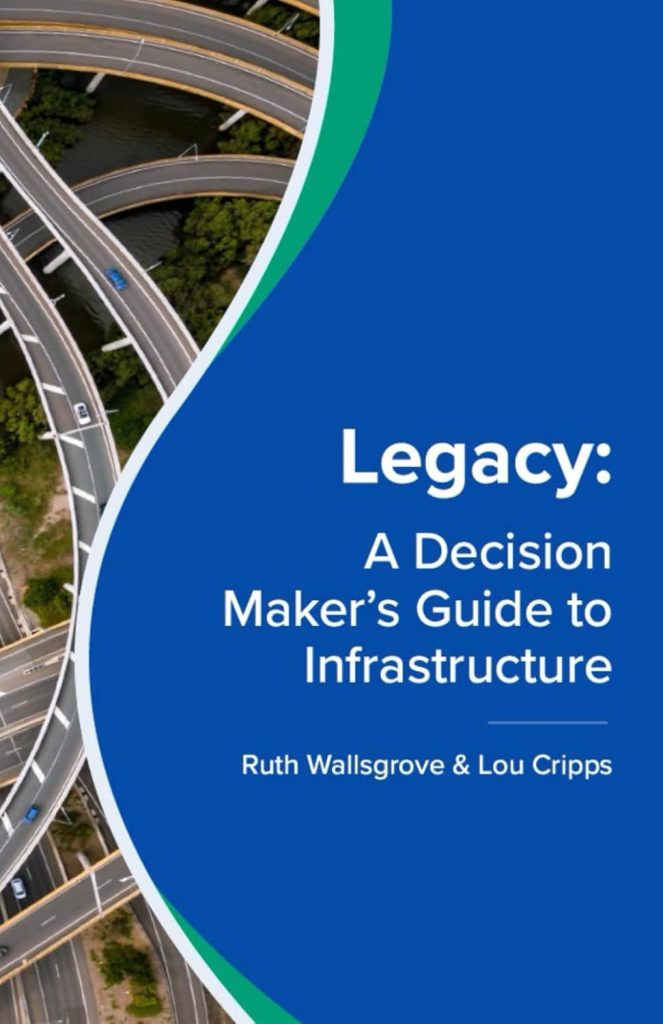
What is your legacy to infrastructure? Not the concrete you pour, but the quality of your decision-making.
Here’s an article on better decision thinking from Talking Infrastructure board member Lou Cripps for the Institute of Asset Management magazine.
https://publications.cplone.co.uk/portfolio/IAM/202507/0010.html
Recent Comments